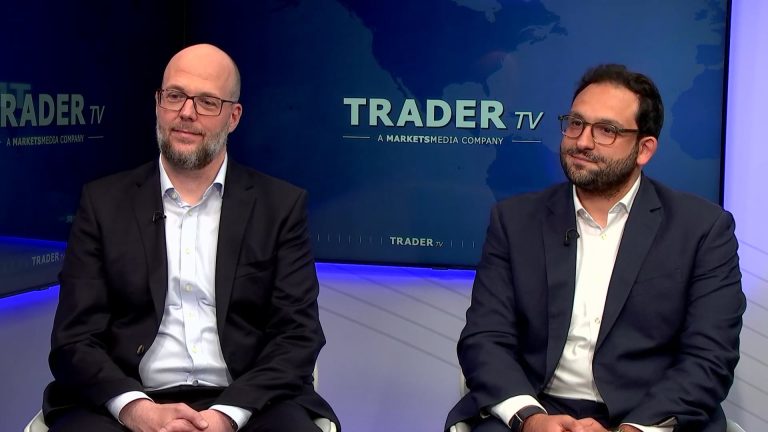
Given the busy, volatile start to 2026, Eric Boess of Allianz Global Investors says it’s the perfect market environment for traders to capitalize on their timing skills. Speaking to Trader TV, the global head of trading discusses recent volatility trends and the growing impact of retail participation in both the US and Europe on market dynamics and liquidity patterns. He also shares his views on the rise of shorter-dated options and their variable use cases, be it for risk management or betting, and flags some of the key upcoming structural changes to trading and fixed income over the coming months.
Interview
Josephine Gallagher – How has your trading desk been interacting with this year’s market volatility, and how challenging is it to differentiate your execution strategies?
Eric Boess – Well, it’s clearly been one of the more interesting starts to the year. I mean, end of Q1 last year, we said this feels like a year already. Now guess what–we’re six weeks into 2026 and it already feels like a year again. So the incoming of noise as well as news flow, has been absolutely astonishing. The resulting volatility from that has made this a super interesting trading environment to start with. I wouldn’t necessarily say that we fundamentally changed the way we traded, but if you just put some numbers on high volatility and high volume, the average traded volume in Europe last year was around 85 billion a day. That’s north of 110 in January this year already. So you see a significant rise in volatility. And it’s not only stocks moving a lot, it’s the fact that they are not moving in tandem. Something that has been, I wouldn’t call it a conundrum. But people have been confused why we get so much geopolitical noise, company news, and index volatility, especially implied volatility, remains very low. It’s not a secret to anyone who has ever done economics or statistics. it is correlation. Because stocks are moving in very different directions, and if you want to pinpoint numbers on that, the average S&P 500 component currently, so the average of stocks volatility in the index is around 42. Implied volatility in the S&P is only 17-18, and that ratio is, by historic means, extraordinarily high so what does that mean? In reality, it means stocks are moving violently under the surface, but the surface stays calm, and that obviously for buy-side traders like us makes for a challenging but potentially very rewarding environment. It’s probably very tough if you are a medium and long-term orientated portfolio manager these days, but traders, we have an eight-hour investment horizon. We have to make sure that we trade within the trading session, and strong moves give a trader, a skilled one, the opportunity to actually show their time skills.
Josephine Gallagher – How much of a role has the retail flow been playing in this market volatility this year and can you compare US and Europe for us?
Eric Boess – Yeah, great question, and an interesting topic, because retail activity in the US is well-documented. It just has grown over, especially the last two decades, as a result of cheaper access, more liquid markets, more access to instruments like options on exchanges like ETFs (Exchange-traded Funds). So there’s a lot of material that tries to pinpoint what US retail does. And frankly, while 30 years ago, you looked at what funds did and what hedge funds did, if you exclude retail these days, you’re missing out on 20% on some days, 30% of the US market activity in trading. So you have to know what retail is doing. Now that is still in its infancy in Europe. It’s sometimes better than people think, because retail activity and stock ownership in Europe are on the way up, but from very low levels. And parts of why it’s even more difficult than in the US to pin down what retail does is because the US uses different instruments. The US retail investor usually goes via stocks, ETFs and listed options. In Europe, they do stocks and they do ETFs, but the listed options markets are pretty much closed to large parts of the retail community, so they use the large certificates and warrants markets that exist here in Europe, which makes it much more difficult to figure out what retail is actually doing. Now, there are some ways to do this, like seeing where volume actually prints on, which exchanges does it print, again, where to trade in Europe, where volume is actually taking place is extremely complex, but can be very revealing if you look a little bit under the surface,
Josephine Gallagher – Does growing retail participation also have the ability to change liquidity patterns in Europe?
Eric Boess – I think this is not only retail, but I think the aggressive exponential price charts of mainly silver, gold, to a lesser extent. That has been clearly written, retail frenzy, written all over it. I was reading the number of a chart in the FT, so it’s not a precise number, but according to that chart, retail bought more than a billion in silver ETFs over a few weeks only this year. Looking at a note from Citadel, precious metals options activity in the US was six times the amount it was last January, so January 2025. Now it’s not a surprise to see it go up exponentially and then collapse almost equally fast. So that’s clearly signs of retail activity. There have been a couple of stocks and sectors where you’ve seen that as well. But how to handle a stock which is more traded by retailers is for us as traders, very important, because retailers transact slightly different to institutional investors. They have a very different risk profile. They tend to be more pro-risk. They tend to be more momentum traders. So understanding whether an asset you’re trading is currently driven by more retail or more institutional flow is something that I think a good trading desk should always keep an eye on.
Josephine Gallagher – As part of this, what interesting trends are you seeing in the shorter-dated options space? And are you seeing a change in trader’s relationship to risk?
Eric Boess – Yeah, (professional) traders probably less so so trader’s risk management skills should be high and constantly high. I think the change in options markets is twofold for this. More and more super short-dated, so zero-day options being traded. They started in the index. They are now available in several single stocks already. So zero-day options, short dated options are clearly the instrument that has high growth rates and that impacts the risk management toolkit that options market makers. But as well, any investor who is actively trading derivatives can use. And while you, if you would have asked me five years ago what I think about zero day options, I would have told you that this is probably where the next disaster is happening. Now, fortunately, I wasn’t on this show then, because I was wrong, and I have to admit, five years later, zero-day options are probably a helpful tool for risk management. They can help to smoothen out certain tail risks. They have no overnight risk. The gap risk that you face overnight is not existing with them. They actually led to some old school strategies like overwriting, to move to different timescales and diversify over different timescales, which helps to smoothen out certain risk profiles. So I think the options activity that you’re seeing, and in some cases that has grown tremendously. January’s activity in options in Europe was 10 times its 10-year average. That is an impressive growth story, and compared to the US, Europe is pretty slow in adopting options trading. But I think this is all, on the one hand, helpful for professional risk management. The flip side is that people can use it as a betting instrument. Now, whether that’s good or bad, I leave that to everybody’s own decision, but clearly a zero day options or something that bets on a particular asset being higher or lower at the end of the day has a certain betting characteristic to it.
Josephine Gallagher – Just to wrap things up, just beyond what we’ve discussed, Eric, what other market trends or execution trends should we all be paying close attention to?
Eric Boess – There are a couple of structurally important ones taking place, at least in Europe. Equities will probably trade like they did historically. We will weather this volatile phase as we did the previous ones. Fixed Income is probably undergoing a massive step change in Europe, because the post-market transparency regime in the UK and in Europe, it’s live in the UK, it will go live in Europe in a couple of weeks in March. That will fundamentally change how we trade fixed income. Now that is a very institutional market. We discussed retail. I think retail is not an issue in fixed income markets. This new transparency regime will have a significant impact on how cash bonds will be traded in Europe. I don’t want to make any forecast as of how exactly, but it’s pretty obvious that will have a tremendous impact, And further down the line, and probably not for this year, but something to keep an eye on is 24/5 trading in stocks, which some exchanges already ramped up. I’m a little bit skeptical about the whole idea, but that’s something to keep an eye on.
Catch Trader TV shows each week:
To watch Trader TV This Week shows go to – Video
Or make sure to follow us on LinkedIn – Trader TV’s LinkedIn
Available as a podcast – Link