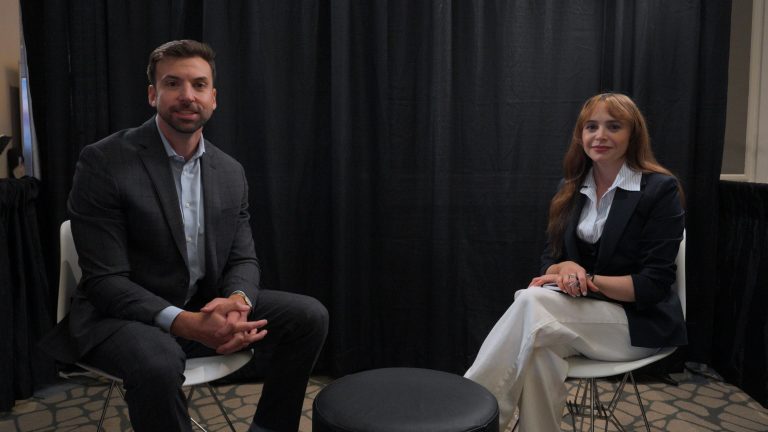
Credit futures are increasingly emerging as a capital-efficient alternative for institutional investors to manage corporate credit exposure alongside ETFs, CDS, and total return swaps. Speaking to Trader TV, Ted Carey, executive director, product lead for US Treasury futures and long-term interest rate products at CME, discusses the drivers behind the accelerating adoption, including margin efficiencies, duration-hedged exposure and growing liquidity across the market.
Carey highlighted increasing execution capacity in larger notional trades through a mix of on-screen liquidity, block trades, ETF-linked tools and specialist liquidity providers. Looking ahead to 2026, he expects broader buy-side participation—from smaller firms to multi-trillion-dollar asset managers—as CME expands product coverage and market liquidity continues to deepen.
Full Interview
Dan Barnes – To start with, we have seen the way that traders and investors are changing the way they manage corporate credit risk. Can you tell us how do you see CME credit futures fitting into this wider macro backdrop?
Ted Carey – Sure, I think it’s best to think about it as far as other macro credit instruments that clients are often managing, including CDS (credit-default swaps), ETFs (exchange trade funds), and total return swaps, so credit futures are a nice complement and addition to that lineup, as providing an alternative way to manage risk, and in particular to directly replicate the exposure of the cash index. The Bloomberg indexes are market value weighted and include all sectors across investment-grade and high-yield credit, and so provide a broad-based way to manage that risk.
Dan Barnes – Why would institutional investors and hedge funds all be looking to use futures in this way?
Ted Carey – Sure, so when you think about it in relation to some of those alternatives, say ETFs, which are fully funded, or total return swaps, which are bilateral, uncleared derivatives, futures are a great capital-efficient way to manage that risk, given the margin requirements that are typically associated with futures. In addition to that, CME is able to provide some unique capital efficiencies beyond that, including margin offsets with Treasury futures of up to about 75% as well as with our S&P 500 futures and other equity products. And then lastly, one of the things that we’ve started hearing from clients is the interest in the duration hedged product, which allows clients to access the credit risk exposure only with no interest rate risk embedded in the contract.
Dan Barnes – Very good. Now, you’ve actually been out on the road talking to clients recently, what sort of feedback have you had from them on these instruments?
Ted Carey – Yeah, sure. So we’ve met with a number of clients over the last month, spent some time on the west coast, and it’s great to be here in London with you this week. I think one of the things that we heard from some of the initial early adopters was for accounts that lacked an ISDA (International Swaps and Derivatives Association) agreement, futures are a great alternative to total return swaps, and that you can access very similar exposure in a capital-efficient and play manner. Another thing that we’ve started hearing from some of these accounts is that really there’s participation from all sorts of different-sized firms, from some of those smaller types of accounts, like I mentioned, but also multi-trillion-dollar asset managers. We’ve heard from clients that they’re finding that the liquidity on the screen is actually quite good, that they’re able to see that the prices are essentially at the minimum tick increment for about 80% of the time, and that through various algos and VWAP (volume-weighted-average price) strategies, that they’re able to execute trades of up to say 20 to 30 million notional on the screen without issue.
Dan Barnes – Very good, that’s an interesting point about liquidity and awareness of liquidity, because traders traditionally might look at the screen and assume that what they see there is everything, but actually there’s a lot of liquidity that can be provided, which is away from that. Can you explain how they might be more conscious of what’s capable?
Ted Carey – That’s right, Dan. So, I think one of the things about credit features is open interest has grown this year, now up to about 2 billion in notional, but I think clients are finding that that doesn’t necessarily always reflect the full depth of liquidity that clients can trade. We’ve seen in some instances that people have relied on our block liquidity providers and are able to execute trades that are as large as the total open interest in a product in a given day. So, for example, a few weeks ago we saw in our investment grade contract a client put on a trade of about 600 million notional over the course of a few hours, splitting that into a few block tickets, and then, in addition to that, clients have really embraced the flexible execution mindset, relying on the screens in some cases, but also we’ve introduced new functionalities like our derived blocks, which allow the liquidity provider to essentially lean on the ETF (exchange traded funds) as a hedge and price the futures as a spread to that, and that has really resonated well with clients to use a variety of different execution methods.
Dan Barnes – Okay, so if I’m going to trade, say, 100 million in notional, what does the workflow look like compared to when I’m trading on the central limit order book?
Ted Carey – Yeah, so on the central limit order book, I’d say we’re regularly seeing clients trade sizes of up to about 50 million notional, but then for trades above that in the block size, we have a strong network of block liquidity providers. We’ve provided a list of some of the banks and non-bank liquidity providers that have offered to provide that type of facility, and we have seen that they’re very willing to price those types of trades. For example, last week in our high-yield contract, we saw several trades of about 140 million notional, and when you look at the quality of that execution relative to the central limit order book, we’re finding that clients are quite pleased by the execution that they’re getting.
Dan Barnes – That’s really interesting. So, looking forward to the rest of 2026 now, what does the year hold for you? What’s the future?
Ted Carey – Yeah, so one of the more recent developments there has been the expansion of our product suite. We recently added a few new products, we added emerging market sovereigns, as well as investment-grade, a short, medium, and long-maturity split product. But really, as we look forward to 2026, I think what we really expect is just the acceleration of client adoption. A lot of clients had been working through their internal governance processes or getting their risk system set up, and so now they’re really able to manifest that enthusiasm in trading the product now that they’ve worked through those various checkpoints, and so we’ve started to see new clients get online each week, growing the participation and user base.
Dan Barnes – That’s fantastic, seeing this level of activity and the range of activity as well is really exciting, Ted, that’s been fantastic. Thank you.