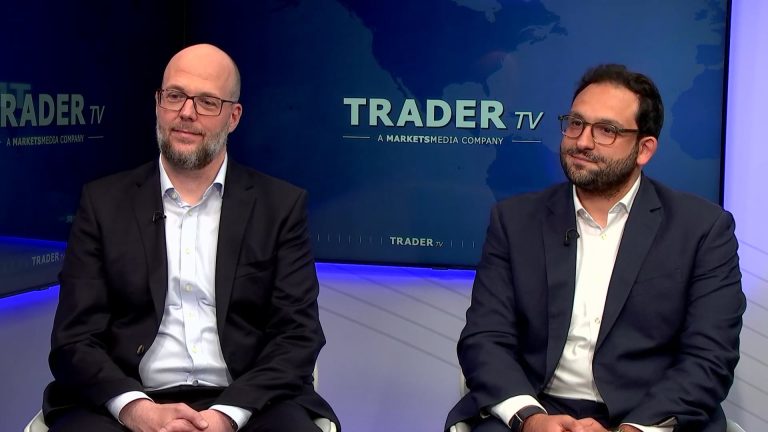
Credit investors are bracing for a pivotal week as central bank decisions return to the forefront, with the European Central Bank expected to raise rates ahead of next week’s Federal Reserve meeting. Speaking to Trader TV, Francesco Castelli, head of fixed income at Banor Capital, says that it could be the end of the “credit markets nirvana” as market estimates believe the ECB will raise interest rates this week.
Castelli also discusses the growing concerns over record-breaking debt issuance from major tech firms funding AI-led projects and says that the concentration of corporate debt could completely reshape corporate credit markets and could drive long-term “generational structural spread widening”.
Full Q&A
Josephine Gallagher – So, to start with, contextualize for our audience, what will be driving credit market activity this upcoming week, and characterize what the liquidity picture looks like right now.
Francesco Castelli – Yeah, I think this week is going to be the central bank show. We start with the ECB (European Central Bank) this week, and then it’s going to be the Federal Reserve next week. And I think the Central Bank cycle, which has been relatively tame over the last few months, will be back with vengeance. The ECB is expected to hike rates, and this, unfortunately, is not likely to be an isolated episode. The ECB can choose the pace, but they can’t choose the direction. Short-term rates, the only way is up, unfortunately. Meanwhile, the credit world is living in a kind of nirvana. Spreads are trading at the tights for the year, and we’re riding the wave of an ebullient equity rally. That rally has done the heavy lifting for us, but last week, volatility is suddenly signalling that maybe this bullish trend might be running out of steam, and so there’s kind of tension in this picture. On one side, the rising rates and hawkish central banks; on the other, spreads really price for perfection. When you are at the tights, and the macro tailwind is fading, you’re not being paid to be a hero. So our recommendation is being prudent in credit.
Josephine Gallagher – I wanted to talk to you a little bit about issuance and corporate financing. So, we’ve seen a substantial amount of debt issuance from tech providers, the hyperscalers of the world, and we notably have a few big IPOs coming up, such as SpaceX. So, are you concerned about the scale and concentration of debt issuance, and the limitations to the spread of capital.
Francesco Castelli – Yeah, tech issuance has been the dominant story in the primary market for the last six months, and it’s really something new. Historically, the investment grade, the tech sector ran almost on no debt and almost no issuance. These were cash machines, companies practically drowning in free cash flow with very strong balance sheets. That word is gone. The hyperscalers are now expected to issue debt in the trillions over the next few years. Our working assumption that probably this sector will issue something between $2 to $4 trillion in the next five years, and this is really to give you a perspective, a huge amount of money. That single wave of issuance, if we’re right with this projection, which is very close, by the way, to consensus projection. We probably represented something between 20 and 40% of the US corporate bond market, which is the largest corporate bond market in the world. One sector, one theme, very, very scary. And yeah, I’m concerned of this concentration. When a handful of names need to raise that much capital, it’s just not; they’re not just tapping the market; they are reshaping it, and they will compete for every dollar on demand, and that has consequences for everyone else, not just for hyperscalers. So this is the supply story that, in our view, will define not only this year but the next few years. And this, the demand of capital is really unprecedented, enormous, with huge concentration, and with huge uncertainty on whether the market will be able to absorb this wave of issuance.
Josephine Gallagher – That’s a really good segue into my next question. So, what do these record debt volumes actually mean for credit market performance and liquidity in the short and long term, and how are you seeing it show up in credit spreads?
Francesco Castelli – Yeah, we think it’s such an unprecedented episode that you need to try and work with something similar in the past to draw a parallel. The parallel we’re trying to draw is the one of the turn of the century. Back then, the big issues was coming from telecom, today is coming from hyperscalers, but the pattern has a lot of similarities. In both cases, we are talking about large near-monopolistic companies throwing off enormous free cash flows that suddenly flip to zero, and suddenly these companies start piling on debt. In the 2000s, they were laying dark fiber and rolling out 3G to prepare for mobile phones. Today is different. They are training large language models and building huge data centers for AI inference. Technology is different, but the playbook is similar and potentially, we are going to have the same hangover. The macro risk is over investment. They are putting trillions into capacity that might not see the promised returns materialized. For credit investors, the similarity with the turn of the century, is that we are not talking about micro problems, we are talking not about company-specific stories, but about a macro story that is going to distort the entire market. These giant issuance is likely to crowd out other borrowers, and in our view, will drive a generational structural widening in credit spreads. Like in the 90s, we are not calling for a sudden jump in defaults. These are very large companies with very strong balance sheets. The outcome, in our view, is the corporate bond sector underperforming as a whole, so you will not see huge defaults, but you will see an extended protracted underperformance in industrial corporate bonds.
Josephine Gallagher – Understood. And so, lastly, as concentration risk becomes an increasingly important theme, like, How are you seeing investors protect against these kinds of risks and potential future shocks?
Francesco Castelli – Yeah, again. Well, I’ve been there before, and so my instinct is to play the end of the 90s playbook. The turn of the century, industrial corporates underperformed, while banks outperformed. So financials are my natural overweight at this point in the cycle. We had big issues back in 2000 for high yield bonds. We don’t expect the same scale of disaster, however, we might see large pockets of default in the liquid markets, especially in the software sector. Illiquid, on the other side for us, are an opportunity at the moment. We don’t invest directly in illiquid debt. What we can buy, however, is corporate bond issued by illiquid alternative investment managers and corporate bond issued by BDCs, companies listed in the US that invest in illiquid credit. So for investors in the sector, we don’t know if retail outflows will stop anytime soon. So we think the sector will continue to be under pressure, but we’re very happy to be creditors to this illiquid sector and to underwriter that risk, because we’re being paid properly, and even if you assume defaults will be much higher than they were in 2008 we think our corporate bonds will not be wiped out. Equity investors may have some decent problems, but not corporate bond investors. So, this is our preferred positioning: favor financials over industrial, we avoid the fragile corners most exposed to software, and we are selectively investing in into private credit.