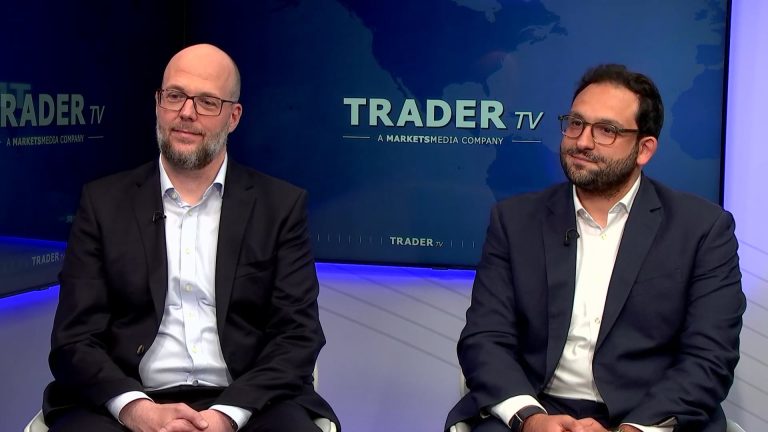
Electronification in emerging markets (EM) rates is gaining momentum despite ongoing challenges linked to market fragmentation, data inconsistencies, and price discovery in over-the-counter (OTC) markets, says Vikas Gupta, head of Asia Currencies and emerging markets, and Cynthia Sin Win, head of APAC e-FICC sales at JP Morgan. Speaking to Trader TV, the JP Morgan executives say that around 50% of the bank’s EM rates trading volume is now executed electronically, with hedge funds leading adoption. Despite this progress, key hurdles remain, including pricing discovery and efficient risk management. Amongst this, they unpack the growing role of AI, data analytics, and automation in resolving these issues and driving further electronification.
Full interview below
Josephine Gallagher – So where are EM (emerging markets) rates in its electronification journey, especially compared to more advanced asset classes like FX, equities, and developed rates?
Vikas Gupta, JP Morgan – Yeah, so given the nature of the product and the legacy behaviour which we have seen in EM rates, I would say it is a little bit of unfair comparison to compare it directly with the G 10 FX or the DM (developed markets) rates, but still, I think the progress which we have made is quite significant. And if I was were to look at our volumes, almost 50% of our volumes are coming in through E-channels in the EM rates now, so that, in itself, is a big step forward, and the changes which we are seeing both internally as well as in the external environment, I’m quite confident that this is just the first step of the big journey, and we’ll be able to reach a stage with what we have been able to achieve in DM rates or the in the FX space.
Cynthia Sin Win, JP Morgan – Yes, I totally agree with Vikas. The EM rate is progressing quickly, like Vikas mentioned, we are already at 50% electronification rate, but it is still earlier in its electronification journey than equities, GTN FX and developed market rates that you’ve mentioned. So those markets have much deeper standardized liquidity and long-established electronic protocols, whereas EM rates have historically been more fragmented across venues and local conventions, and because standardization is harder when market structure varies by country. So because of that, you will see EM is not as electronicified. However, the direction of travel is very clear. Clients are increasingly wanting measurable outcomes in terms of their speed of execution, the consistency of their pricing, and the auditability of their prices and trades that they have done. So electronification is the mechanism to deliver the solutions for what the client is looking for, and it is the solution for today’s trading climate.
Josephine Gallagher – So as you mentioned, electronicifying EM rates is much more challenging than more liquid assets. Could you tell me a little bit more details about some of the key challenges and nuances involved?
Vikas Gupta, JP Morgan – I would look at it from a trader’s perspective, the two key challenges which we face are, first, price discovery. Most of these markets are OTC (over the counter) markets. There is no one single screen or platform or an exchange which I can look at and use that as the primary pricing input. So it is a function of trader’s own expertise, experience and the fragmented information which is available in the market, on the basis of which we arrive at the mid-price. And second is risk management. Unlike FX, or equities, where we have very high rates of internalization, EM rates involve quite a bit of warehousing of the risk, and the approach then which we have to take to the pricing is very different, and the way you measure the profitability and the risks involved. That in itself creates unique challenges.
Cynthia Sin Win, JP Morgan – Yes, and I will add, from the sales perspective, what we see is like Vikas mentioned the market diversity, where EM rates is not one market. So the market structure of individual countries varies in terms of documentation, there are holiday calendars, settlements. So because of that, it is challenging to have just, you know, one size fit all solution for market diversity. And then secondly, there is data fragmentation, where there is multiple different sources of data. So real-time pricing requires stitching of multiple different data sources, normalizing these data sources and also managing whatever gaps that we do have. So without normalization, these data and the automation of such pricing will create errors, and that is the last thing we want. And so we do have to work on data discipline. And in terms of data at JP Morgan, we invest a lot in data normalization, robust pricing and risk frameworks and the ability to support multiple trading protocols, and also trying to translate lessons that we have learned from DM rates and try to apply to EM rates. So in terms of that, we are trying to manage these challenges. And last but not least, I would like to mention in terms of client behavior and the protocol complexity of clients. So EM clients have very different needs. Some want very high frequency, systematic assess, and others want more slower discretion, and, you know, risk transfer prices. So the winning model will be trying to have streaming, where we can support it, and RFQ, where clients are able to request us for competitive pricing and then also have high-touch solutions.
Josephine Gallagher – Gotcha. Now moving on from challenges like what kind of client segments or regions are actually like leading the way in terms of the development or the electronification of EM rates?
Vikas Gupta, JP Morgan – So if I were to go by Asia’s experience, systematic hedge funds, they have been the leaders in this particular field. They are very, particularly focused on the ease of execution and the cost of execution. And both these aspects feed directly into electronic execution and the electronic pricing, because it essentially influences the speed at which we are able to quote the consistency of the spreads and the post-trade workflows. So normally in Asia, we have seen that they are the leaders, and they are the ones who are setting the agenda in terms of electronification from the dealers.
Cynthia Sin Win, JP Morgan – Yes, I totally agree with Vika. Systematic and quantitative clients are at the forefront. And originally, you can see from this chart, APAC has been a notable leader. We are at 38% of the global volume in EM rates trading, and that is also because we have the client base and market hours that create a strong use case for electronic access. So particularly as global investors want to engage with Asia EM products, having an electronic access is the easiest way for everyone to be able to access these countries, even outside of onshore trading hours. And what we are increasingly seeing is evolution from, you know, sometimes RFQ (request-for-quote) here and there, to more continuous streaming or click-to-trade pricing for certain clients, and that creates a roadmap for extending electronic access for our broader client segments, even in EMEA and in US based clients to engage with us in Asia EM products.
Josephine Gallagher – And so how are advanced analytics and AI changing the way you price, manage risk and automate EM rates, and what impact is that then having on liquidity and trade efficiency?
Vikas Gupta, JP Morgan – So these new tools which are coming into play with AI, I think, have direct positive impact on both the challenges which I mentioned earlier. Now we can analyze much more data in very advanced manner and come up with the more sophisticated valuation models where I can come up with my own models which can analyze even the limited data and generate a fair value. And secondly, in terms of the risk management, I can carry out much more sophisticated ‘What if’ kind of analysis that if I were to be holding a certain risk for a certain time horizon or hedging it indirectly through other instruments, how the P&L (profit and loss) and what the revenue outcomes will look like. On both counts, these new tools are enabling us to provide more liquidity in bigger sizes and faster pricing to our clients.
Cynthia Sin Win, JP Morgan – Yes, and I will add that from a client-facing standpoint, the biggest impact that advanced analytics and AI can help make electronic markets more consistent and scalable and better data handling and smarter automation to support more reliable pricing and improve workflow and smoother client experience. So the outcome that clients want is, you know, faster response time, fewer operational frictions or challenges, and more dependable electronic access. And you know, for JP Morgan, wherever the client is, we will be there in whatever channels they need to meet them.
Josephine Gallagher – Interesting stuff there. Now, looking ahead, how do you expect EM rates, electronification to reshape the competitive landscape and the role of market participants globally, including overseas clients in EMEA and the US engaging with APAC EM products?
Vikas Gupta, JP Morgan – I think electronification will make our markets more liquid and will make it easier for clients to participate in our markets, and especially if we are delivering them on the same platform, same processes and in the same manner as they are dealing in with the DM rates in their respective time zones. And more importantly, as I said, new AI tools, if they help us. In more efficient risk management, it will improve our ability to hold risk, bigger risk, for slightly longer periods of time, and obviously it will help in improving the liquidity that we can provide to our clients. So I’m quite excited that the advancement which we are seeing within JP Morgan, and the efforts we are putting, in terms of arriving at fair values on various curves, the kind of structures which we can offer, and our ability to price bigger risk electronically, it will improve the client experience and the liquidity and, more importantly, access to the Asian markets.
Cynthia Sin Win, JP Morgan – And I think electronification will raise the bar and reshape competition in two ways. It will differentiate banks and liquidity providers that invest in scalable pricing, data foundations, which we talked about, and automation from those that primarily still rely on manual, episodic workflows. So because the former can actually support more clients more consistently and with better controls, there will be a real, you know, like adapt or be left behind, kind of dynamic in the competition space among the banks and liquidity providers, but it is also for clients. So clients who modernize in their workflow and come on to electronification will stay competitive, and those who don’t will probably be left behind. And then secondly, it will also accelerate global participation, which we spoke about earlier. Like electronic access improves, there will be overseas clients and engaging with Asia EM which to Vikas’s point it will actually help with the overall liquidity because of additional market participants. And from APAC electronic sales lens, this is the exciting part where Asia EM not just becomes a local market and just a regional market, but it will become a global use case for how EM electronification can broaden access while still, you know, respecting the specific nuances that we have discussed about of individual countries, liquidity and market structure.
Josephine Gallagher – Thank you very much, Vikas and Cynthia, for joining us.