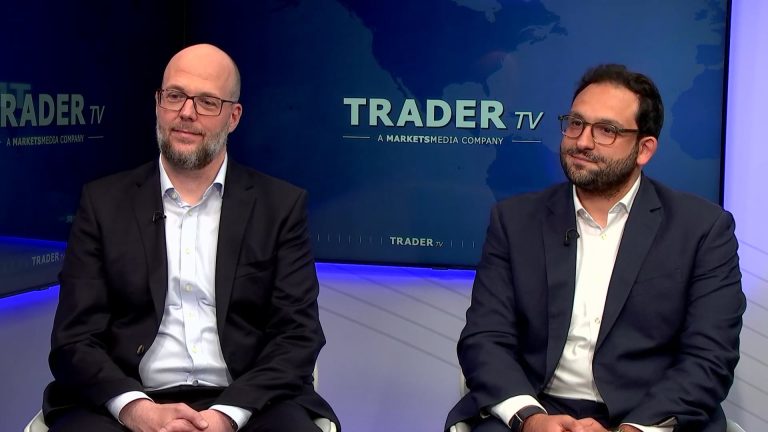
In Trader TV This Week: Marcin Zdunek at F/m Investments notes that while markets think inflation is no longer an issue, the Federal Reserve is still struggling with it. He is watching the relationship between the two-year Treasury and the ten-year Treasury two year and ten year Treasury keeping an assesses the risks facing fixed income investors
Traders can expect a certain amount of volatility across equities and fixed income, while a big ongoing directional move is underway out of risk assets, suggesting a directional strong buy into investment grade and sell out of high yield, making liquidity worse for firms trading into the current as bid-ask spreads move against them.
Interview Transcript
Josephine Gallagher: Macro factors continued to dominate trading activity, but there’s a lot of contradictory data out there. What should traders be paying attention to?
Marcin Zdunek: I would say keep your eye on the relationship between 2 and 10 year bonds and where that goes. Contradictory data. Of course it’s an issue. Powell mentioned it in his recent speech. There is an obvious slowdown, but yet inflation numbers are somewhere around 3%. I think that’s what the Fed is struggling with. If you cut the rates too much, you can stimulate the economy too much and inject too much of that cash into the pockets of our consumers and flare up that inflation number again, which would be an absolute disaster. So we see where he’s coming from. But markets seem to think inflation is no longer an issue. What is going on in interest rates and the move specifically in the ten year bond, we see 75 basis points cut by year end. It’s all data dependent, as for Powell but certainly, cuts are coming. Europe’s already started it. We are maybe slightly behind the curve here.
Josephine Gallagher: We’ve seen this major move out of risk assets. How do you see this volatility across equities playing out for the rest of the year?
Marcin Zdunek: I think it’s going to be a lot more volatile. So, you will have days where equities could be down 3, 4 or 5%, and you’re going to have days where ten year bonds can trade up or down 3 or 4 points, just because we are still very uncertain of what’s coming. But we also know that the recession appears to be getting closer and closer to slowdowns there. The consumers are buying less and are less confident and a lot more strained. People have big gains in their equity portfolios. And if you’re expecting a recession, that’s all you hear on the news all the time, you’ll try to capture some of that and you have to go somewhere else, right? So you’re going to be going to US Treasuries, maybe investment grade (IG) corporate bonds, maybe even some quality high yield. The way we see it, US Treasury duration, somewhere between five to 10 years is where you want to be. We’ve done that in our portfolios. In addition, we’ve moved away from lower quality consumer financials, specifically in high yield and into higher quality energy names that are rated, so, for example, you know, selling, CCC financial names and buying a BB energy name, an investment grade, similar to building up a higher quality portfolio and selling lower quality. So selling BBB- and buying single A’s and high BBB plus. That’s where we like to trade.
Josephine Gallagher: Europe saw a tick up of inflation recently. Should trading desks be concerned about the potential of overall inflation making a comeback?
Marcin Zdunek: Certainly that is a huge risk. And I think Powell indicated that in the last meeting and testimony, we think inflation is no longer a significant risk in the United States. In Europe you still have some of that. So the way we protect ourselves, the way we hedge ourselves, is that we stay in the belly of the yield curve. So somewhere between 5 to 7 year, 5 to 10 year where you are cushioned against maybe huge interest rate selloffs and spikes in inflation.
Josephine Gallagher: Are markets underestimating geopolitical risks, such as the potential escalation of the conflicts in the Middle East?
Marcin Zdunek: One hundred percent they are. If you look at the market valuation of credit spreads both in high yield investment grade and in European spreads, if you look at the market valuation of equities, even with the recent sell-off, you would think the world is in a great shape. You wouldn’t think that there’s anything wrong in the world. So markets are not indicating that there is a geopolitical risk. And of course it’s a mistake. You have to be ready for it. Certainly the Israeli-Palestinian conflict continues to escalate. People are still dying in Ukraine, and that could easily flare up. The only place where you might see some of that play out is US Treasuries. But, you know, that’s really driven by what is going on in the economy and the fact that we are going to see wage cuts coming up. The way we’ve positioned ourselves is by buying energy. You know, obviously you want to own oil when things are going bad in the Middle East and you want to own higher quality credit, defense and energy and that kind of businesses. So that’s what we have been doing. But I’m not sure if it’s exactly driven by the geopolitical events, but rather just a move to higher quality, away from risk.
Josephine Gallagher: And what’s one piece of advice that you would offer traders going into the upcoming week?
Marcin Zdunek: One don’t wait too long, because the waiting itself to move from risk to quality is going to be what determines whether you’re in a positive territory or negative territory in how you perform against your peers. So, it might be painful to do, but buying quality duration, maybe to trade for the retail investors is easy to do, right? You can just buy and sell ETFs. It’s a click of a button. You can move your allocation from equities to investment grade corporate bonds, European corporate bonds, US Treasuries, whatever. It can be done in less than a second. Once everyone starts selling those equity ETF or buying the US Treasury ETFs, you may be too late. Right. Because there’s just so much money moving back and forth. So volatility will increase. The bidding offer spreads will increase. And you’re going to lose some of that return you could capture by being early.
Catch the show each week:
To watch other Trader TV This Week shows go to – Video
Or make sure to follow us on LinkedIn – Trader TV’s LinkedIn
Available as a podcast – here