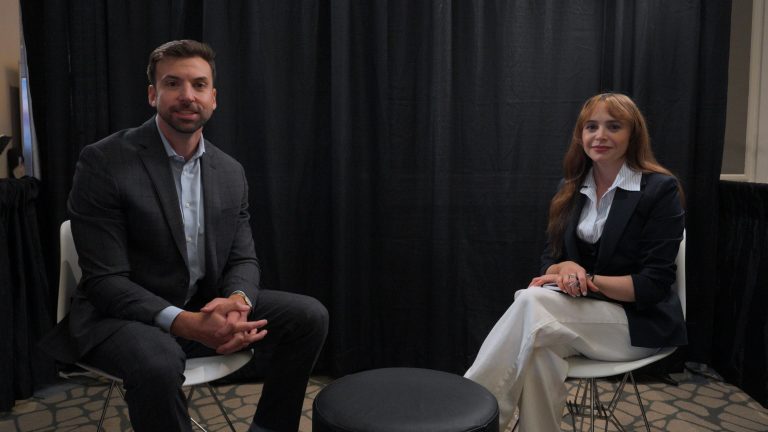
Khursheda Fazylova was always curious about the capital markets from a young age, particularly from growing up in post-Soviet, Tajikistan. Today she sits as a junior trader at State Street Global Advisors in London covering fixed income and using her tech skills to create efficiencies on the desk.
In this episode, Fazylova speaks to Trader TV about her journey into the curious world of finance and the advantages of being a digital-native 90s baby who can offer a fresh approach to using new technologies, coding, and automating tasks.
Fazylova also discusses her outlook on where technology can make the biggest impact on the fixed-income markets’ journey to electronify and unpacks her views are on zero-touch trading.
Interview Transcript
Jo Gallagher Welcome to Trader TV Generation Trader, where we look at the positive impact of diversity on the trading desk. I’m Jo Gallaher. Today I’m joined by Khursheda Fazylova a junior bond trader at State Street to discuss her journey to finance and how the younger generation are transforming the trading desk. Khursheda welcome to the show.
Khursheda Fazylova Thank you.
Jo Gallagher To kick us off. Talk me through your journey into finance.
Khursheda Fazylova I’ve always wanted to work in the financial markets. I’m from a very small post-Soviet country called Tajikistan, where we never had free markets before and we were an independent republic for just 20 years. Back at the time when I was a student, the only way for me to learn was to move abroad. And this is what I did. First, I moved to Poland to pursue my first master’s degree, and then I moved to France to pursue the second one, both of which were in finance and corporate finance.
In 2019, I moved to State Street Global Advisors to the fixed income portfolio management team as a quant researcher and a portfolio manager assistant, where I was very lucky and privileged to work on some exciting fixed income strategies and portfolio optimization projects. Two years ago, I moved to a trader role here in London on a fixed-income trading desk where we trade government bonds, we trade credit, we trade convertible bonds, we trade derivatives, and high-yield leveraged loans but my main focus is developed world rates.
Jo Gallagher What inspired you to pursue a career in capital markets?
Khursheda Fazylova The only image of the financial markets I got back when I was a child was through the movies about the global financial crisis, and that sparked my curiosity. Also, my whole family is very academic, [they are] very well-known scientists. It’s a very theoretical field and I like things that are more hands-on. So naturally I was drawn towards something that is dynamic enough to challenge your brain, to challenge your intelligence, but also is very practical and you can see the added value physically. So for example, let’s say if you invest, how much is the return? And if you trade, what’s your tracking error? And I think the world of finance suits my personality and that was my inspiration.
Jo Gallagher How did your background and skill set shape the way you trade?
Khursheda Fazylova I think because my career at State Street started on the quant research desk, I learned to be very efficient and fast in processing big data. Also, given that I was born in the 90s and I’m a typical 90s baby who uses the internet and technology, I try to automate as much as I can, and I think coding helps a lot with that. Maybe we are a bit lazier than the previous generation, and we don’t like to sit for hours building spreadsheets in Excel, which have 20 tabs.
I think it’s not enough to be just versatile in financial subjects. You also have to be able to code and automate. Otherwise, you will be swamped, you will be very inefficient and you will be making a lot of mistakes. Because if you calculate things manually, there’s a big risk of a fat finger and then it can lead to losses.
Jo Gallagher Where do you see technology and electronification making the biggest impact in fixed income?
Khursheda Fazylova So unfortunately in terms of electronification, we are not yet at the level at which the equity markets are. Fixed-income markets are very fragmented and there are different pockets of liquidity, some of which are very hard to access. During Covid, though, we could see the benefit of electronic trading and Covid has helped a lot of buy-side asset managers realize how important it is to be in touch with technology, and how important it is to streamline your process, and electronification is a very good tool to use.
Thanks to various platforms that are available now to fixed-income traders. 70% of the IG credit universe here in Europe is traded electronically, a big chunk of which is auto-executed. So meaning there is some rule-based approach that you can code into a platform. So it helps divide your workload into the stuff that you don’t want to touch and the stuff that you want to focus on. But if something like Liz Truss happens again and people panic and shut down all of their platforms, you still would need a human trader to go and trade voice. That’s why I think Zero Touch is still a bit out of reach for us. Once volatility spikes up. Once people panic, the machine cannot cope with it. You basically need to go back to the human.
Jo Gallagher What advice would you give someone of your generation or younger thinking about a career in trading?
Khursheda Fazylova I would advise [them] to be curious and to be fearless, not be afraid to compete. Yes, I understand that the competition is very fierce nowadays because everyone is so brilliant. I’m from a very small country, very far away. And if I could do it, you can totally do it. I would also advise to study data science because even if trading is overtaken by AI models, you still need to understand what’s within that black box and how it works. And I think in the future, the trader is sort of like a hybrid in between a data scientist and a trader in a classic sense of that world.
I would also advise not to be afraid to express yourself by questioning everything around you and regardless of your gender, where you are from, or how you were raised, you will always find a place in the financial markets because it’s such a diverse place. So just work hard and it will pay off.
Jo Gallagher I would like to thank Khursheda for her insight and of course you for watching. To catch your other shows, including Trader TV This Week on Mondays at 6:45 a.m. UK time, go to Tradertv.net.
Catch the show each week:
To watch other Trader TV This Week shows go to – Video
Or make sure to follow us on LinkedIn – Trader TV’s LinkedIn
Available as a podcast – here