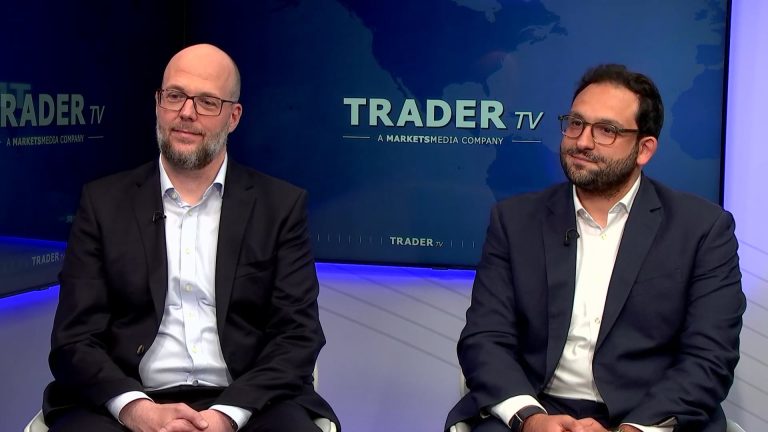
Jamie Anderson, head of US trading at Insight Investment, speaks to Trader TV about the importance of mitigating information leakage and how his team is adapting its strategy to minimize execution costs, as we enter into, what looks like a higher-volatility regime.
The head of trading discusses what goes into the buy side’s protocol section process; what factors go into the timing of the trade and how they are trying to balance transaction costs with implementation shortfalls.
In this episode, Anderson unpacks how portfolio trading (PT) factors into Insight Investments’ trading strategy, whether it’s a good time to be using PT for credit, and how the trading desk is communicating with portfolio managers when it comes to correlation between asset classes, and how this could play out this year.
Interview
Jo Gallagher Welcome to Trader TV This Week, your insight into how trading desks can prepare for the week ahead. I’m Jo Gallagher. Today I’m joined by Jamie Anderson at Insight Investments, to discuss the main topics and events leading this week. Jamie, welcome to the show.
Jamie Anderson Thank you.
Jo Gallagher When there are spikes in realized volatility, mitigating information leakage becomes hugely important. How do you strategize for this?
Jamie Anderson What happens when you have realized volatility is that you have a broader dispersion of potential outcomes over short periods of time, which for market makers who are pricing the risk for the buy side in some sort of risk transfer, that increases the costs to the buy side because the market makers are uncertain over their short time periods, which direction that position is going to go.
So what we try to do when we have these periods of high realized volatility across asset classes is spend time really thinking about what the risk profile looks like from the market maker’s perspective. We try to be very selective in the protocol use and we try to limit the number of people that we show our inquiries to so that it allows the market maker the opportunity to successfully offer the position and the risk to us at a reasonable cost and at the same time give the market maker an opportunity to actually hedge himself or herself. And remember, there is also, in many cases, a directional component to an increase in realized volatility. And so the protocol selection and the way that we engage the market may differ depending on the Delta One of the position and whether or not we’re moving with the market or whether we’re moving against the market.
If we’re moving with the market, that’s where we really have to make sure that what we’re doing and the way that we’re approaching the market is such that it gives the market maker an opportunity to actually make a reasonable price and give him or her a reasonable opportunity to cover that risk. It’s a lot easier if you’re moving in the opposite direction because when you’re moving in the opposite direction, then there’s a lot of liquidity. And so realize volatility in and of itself is complicated, but then complicated again by the fact that it often comes with some movement in the underlying asset.
Jo Gallagher Expanding on the electronic trading side of things. What goes into your protocol selection process as we transition into this seemingly higher volatility environment?
Jamie Anderson Yeah. One thing you have to be aware of, and I think traders have to be aware of this all the time is the trade-off between transaction cost and implementation shortfall. So transaction cost is obviously how much are you paying for something from some observed mid-price, which we always want to minimize. But then the protocol selection should work to both minimize that transaction cost and also ideally minimize the implementation shortfall.
Implementation shortfall is the difference between the price of an asset when it arrives at the trader’s desk and then when he or she actually completes the trade. So often you have to make sure you strike that balance of understanding. Am I minimizing transaction costs but exposing my client to implementation shortfall or am I doing the opposite? And so what happens here is that as this realized volatility starts to increase and we start to go through this logic of how do we approach the market for each asset. We spend more time with the PMs trying to understand and trying to communicate to them just exactly what that trade off is between transaction costs and implementation shortfall.
Because some of that risk on the implementation shortfall falls into the PM role in terms of the discretion over the timing of the trade. So these factors, transaction costs, and implementation shortfall, really do drive our decision over which protocol to use in addition to working even more closely with the PMS, as you realize volatility starts to increase.
Jo Gallagher How does portfolio trading factor into your trading strategy and is now a good time to be using PT in credit?.
Jamie Anderson So right now I think the answer is probably a resounding yes. I think realized volatility in the different asset classes has been different. Right? So a lot of the headlines and everything that we’re seeing from a macro perspective are impacting some of the macro assets more than some of the credit assets. So, for example, FX, rates, and equity versus credit. Certainly here in the U.S. And so right now, realized volatility in U.S. credit is relatively low and in a relatively low realized vol environment.
Then the cost of risk transfer and the risk transfer through the protocol we call portfolio trading is actually relatively cost-effective. And so we’ve seen an increase use in the U.S. of the protocol, both in investment grade and in high yield. So the question, I guess is when we enter into a higher vol regime, whether or not that protocol can still be used. And so our experience so far through previous high-realized volatility regimes has been that it’s still an effective way to move risk. And it comes back to the point that we were talking about earlier, which is the directional bias of assets and the correlation of the direction of asset with realized volatility. So clearly, if realized volatility spikes via moving against the market, then there’s lots of liquidity, and portfolio trading is a fantastic way to move risk.
But even when you’re moving with the market, the ETF ecosystem itself offers dealers a way to move bonds. And so because they can still use the ETF to facilitate balance sheet velocity, we often find that we can actually transfer liquidity, even when we’re moving in the same direction as the market in those periods of high realized volatility. So I think this is a great innovation that the market has actually gone through that really kind of helps the buy side for sure in terms of liquidity provision in both low and high-realized volatility environments.
If we transition out of this low volatility environment that we’re experiencing now into something that’s significantly higher, we still expect to be able to use portfolio trading to facilitate risk transfer. The price at which we’re facilitating that risk transfer may increase as dealers become aware of the realized volatility of the potential outcomes and start to consider some of the factors, the nuanced factors, within the portfolios that are trading. But it should still hold true that that protocol is an effective tool for both the buy side and the sell side.
Jo Gallagher Positive asset correlation is a big consideration for trade desks right now. What kinds of conversations are you having with your portfolio managers around this and how do you see asset correlation playing out for the rest of the year?
Jamie Anderson Correlation and the stability in correlations often is related to transaction cost. So just like transaction costs generally speaking, increase with realized volatility, with the instability of correlations across asset classes, that also introduces higher transaction costs. When you think of a market maker and how he or she may hedge her book, it often involves buying and selling other assets against the assets that have actually sold to the buy side.
So as that correlation structure becomes volatile and uncertain in and of itself, then the sell-side market makers become less certain about being able to run a position in one asset against a position in another. And then that leads to higher transaction costs. So we pay attention to what’s happening in these other assets, even though we may not be as directly involved in them as some of the other assets that we actively trade. To monitor those correlations, to make sure that we understand if the correlations are stable or unstable. And what that means both for the markets that were actively trading on a regular basis and what that means potentially for the way forward.
Again, if correlations start to break down, you know, there’s a couple of different things that could be happening. We could be exiting one regime, entering another, or it could be a temporary aberration where something is impacting one market and not another. We really do have to think about that correlation structure and keep an eye on it so that we may actually get an early look at some regime shift if we are in fact leaving what is a relatively low-vol environment generally and heading into a higher vol environment for the rest of the year.
Jo Gallagher Thank you, Jamie, for your insight. And of course, you’ve been watching. It’s been Trader TV This Week.
Catch the show each week:
To watch other Trader TV This Week shows go to – Video
Or make sure to follow us on LinkedIn – Trader TV’s LinkedIn
Available as a podcast – here