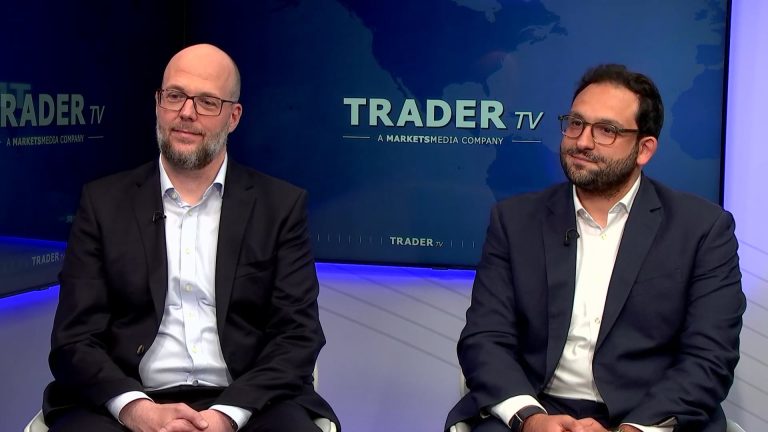
Olivier Cajfinger, managing director at JP Morgan, spoke to Trader TV at this year’s Fixed Income Leaders’ Summit in Paris about emerging trends in portfolio trading and where he sees growing demand for PT and diversification of execution tools.
The MD discusses the momentum behind this growing appetite for customized solutions, tool selection, the wider impact of exchanged traded funds on portfolio trading, and the developing interest in illiquid credit markets.
In response to these trends, Caj also unpacks how the dealer is adapting its line of services to better manage and recycle risk and deliver customized, corporate bond pricing information via its tool Vida Portfolio Solutions.
Interview Transcript
Jo Gallagher Welcome to Trader TV your insight into institutional trading, I’m Jo Gallagher. I’m here at the Fixed Income Leader Summit (FILS) in Paris and I’m joined by Olivier Cajfinger at JP Morgan we’re discussing emerging themes in portfolio trading and the diversification of execution tools. To start us off with, tell us, what are some of the big trends you’re seeing in portfolio trading?
Olivier Cajfinger Portfolio trading has become a proper label for various businesses in the credit markets, and it’s acting as a group for all the various operations that we run at JPMorgan. If you look at the size of the different trading teams we have globally, it’s a very good indicator of how important this agenda has become. We have now ten traders in the US in portfolio trading. We have five traders in Europe and we have now a new presence in Asia because activity in portfolio trading has picked up there. Five years ago we only had one person.
Now we have an army of quants, of tech developers, specialized tools, and more. The adoption of the portfolio tool has grown massively. Our clients are using it more and more. If you look at the year-to-date volume in the US, volumes have doubled. In US IG portfolio trading. They are up 50% in US high yield/. They are up 30 to 40% in European high yield. They are up also in Munis. So the trend is there and these data are clearly showing that the adoption and the growth of that tool is global across asset classes.
Jo Gallagher How does JPMorgan then manage its risks when it comes to these kinds of trading activities?
Olivier Cajfinger So the risk management of those trades is being done at the desk-wide level. There is no way we are going to have each trade being shown to every single trader. It’s not the way we want to scale the business. So there is a globalization of the risk and we look at it region by region and business by business. Centralization of the risk allows us to recycle the risk in an efficient way.
We have invested a lot of money and resources into that agenda to create seamless tools for our clients. To be efficient in the way we price risk. But don’t get me wrong, our appetite to invest money into that space is as strong as it was before because we want to keep increasing the velocity of the turnover of the portfolio trades. We want to improve the easiness of execution for our client and we want to keep on providing customized solutions to our investors in that agenda.
Jo Gallagher So what are you seeing in terms of effects on fee compression and what role does ETF play in that?
Olivier Cajfinger So definitely fees are compressing and as a consequence, our investors are reorganizing themselves and changing the structure of the execution portfolio. Trading represents a one-stop shop solution and that is a decent proposal for them. Clearly, ETFs have grown in our market. You keep on hearing about it every single day. ETFs are being used in the way we deal with our systematic market-making.
ETFs are being used for us to hedge our risk, to manage our risk, to offset our long position to hedge our shorts and just basically to make the risk more liquid. It means that we are seeing many more tactical trades than we used to see a few years ago. It used to be more strategic and direction than trade. However because of the economic value proposition that the PCE tool offers now with the usage of ETF. Clients feel much more comfortable using the PCE tool for those tactical trades.
Jo Gallagher Just to piggyback on that, tell me a little bit more about what you’re seeing and how that’s changing the way people trade.
Olivier Cajfinger On any given day. You will see the average PT being between 50 and $70 million with a hundred lines. But the largest trades are becoming larger and larger. We have recently executed an 8 billion portfolio trade, which we believe is the largest trade in the street on a risk basis. And this trade was an extension of duration that an insurance client wanted to execute. There are definitely many more strategic trades happening. It can take the form of an optimization for an insurance mandate.
It can take the form of a cross-currency trade. We are seeing clients upgrading the quality of their portfolio. Recently we saw clients selling a couple of billions of triple B minus bonds to buy another couple of billion of single-A bond. We have seen clients selling a portfolio of 30-year bonds via a bond TRS. So there are various thematics that we are seeing in the market. What we are doing is leveraging on our platform by involving the strategy team, the research team on top of naturally our trading team to make sure that we deliver the right customized solution for what our clients want to achieve. To that extent, we have launched a tool called Vida dedicated to portfolio trading.
It allows clients to analyze and price their corporate bond holdings instead of sending emails with Excel spreadsheets or sending messages with a long list of ISINs. Clients upload their portfolios and they get instant pricing. They also get a lot of analytics. The overlap with ETF to liquidity score, sustainability metrics which are very important in this market and plenty of other data. The feedback we gather on Vida from our investors in these last few weeks and months has been very positive and we keep on onboarding new clients as we speak.
Jo Gallagher Brilliant. And then what other opportunities are you seeing emerging in credit markets?
Olivier Cajfinger Our clients are also focusing a lot on what we call illiquid credits. Private credit, alternative credit and IG private are buzz words these days in the markets. Our clients are hiring dedicated investment teams to invest in those opportunities. We are organizing ourselves also to make sure that we can respond to that demand. We have more people originating and sourcing that kind of transaction. We have dedicated alternative credit sales as well to cover the new clients. We are trying to create structured deals using the technology of the derivatives market, the technology of securities and the technology of repackaging. And out of these free technologies we are structuring products that can feed the appetite of our investors.
This year we have completed several transactions, some of them pretty sizable. An example, we’ve been working with a corporate and we took an asset of the balance sheet and repackaged it into an SPV. We worked with rating agencies to get a private rating. We worked to get a listing and we then subsequently sold it to a few institutional investors. By involving institutional clients, we provide our corporate clients with a new source of capital, but also a strategic partnership with new investors. And for our end investors, it was a new way to source a different type of risk, which offers a premium compared to what they can find in the public markets. So we have created a tailored solution and everyone is benefiting from it.
Jo Gallagher I’d like to thank Caj for his insight and, of course, you for watching this has been Trader TV at FILS.
Catch the show each week:
To watch other Trader TV This Week shows go to – Video
Or make sure to follow us on LinkedIn – Trader TV’s LinkedIn
Available as a podcast – here