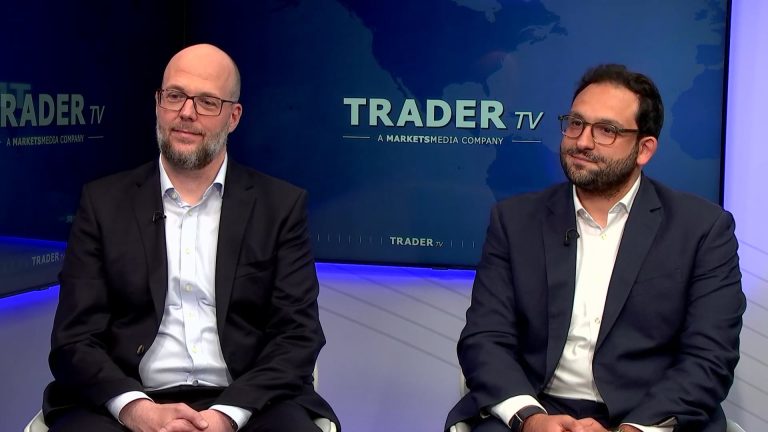
Ahead of JP Morgan’s new research into electronic trading, the ‘2025 E-Trading Edit’, Scott Wacker, head of e-commerce sales at JP Morgan spoke with Trader TV about the market’s expectations in 2024
The continued electronification of markets across asset classes belies considerable further room for evolution, in the increased use of technologies such as artificial intelligence and increased prospects for the use of single dealer platforms to support liquidity access across markets throughout different levels of volatility and directionality.
Interview transcript
Dan Barnes Welcome to Trader TV, your insights into institutional trading, I’m Dan Barnes. With me in the studio today is Scott Wacker, head of e-commerce sales at JP Morgan to review 2025 activity against expectations found in the bank’s E-trading survey. Scott, welcome back to the show.
Scott Wacker Thank you, Dan.
Dan Barnes How did activity play out and did it meet expectations?
Scott Wacker I think broadly it did. If we take a step back to actually what the survey highlighted, I think, first of all, 100% of the survey participants expected there would be a continued move towards electronic trading, that electronic volumes would grow. Second of all, I think there was some concern around liquidity. And finally, I think there was a view that we would see heightened volatility as well. We did indeed see electronic volumes continue to grow. So if we just look at some of the asset classes, G10 FX was up 15%. Rates was up as well, but interestingly, separated between securities and derivatives. Interest rate derivatives were up 15%, securities up 8%. Obviously, with inflation driving interest rates around, we saw very strong increase in interest rate derivative activity. What was surprising was commodities. So commodities was up 32%. That’s quite striking and I guess it really plays to some of the geopolitical issues. You know, we have conflicts in the Middle East and Ukraine, etc.. And I think that that has actually affected a lot of commodity trading. One area which, again, the survey anticipated further growth on the electronic side was in credit trading, but actually in G10, credit volume shrunk by 6%, which is kind of unusual given the markets have been so active. I think a lot of it has to do with really market structure. I don’t really think that we have quite progressed electronic credit trading to the point where we can sort of see the direct correlations in terms of market movement and electronic trading. So credit trading as an asset class, it was one of the outperformers. But I think a lot of that was really driven by voice trading because the electronic capabilities, at least across the main market makers, are not there. So if you think of the main electronic credit market makers, the development, the API, etc. are not quite as advanced as they are in the other asset classes.
Dan Barnes Looking at the macro issues, how do they play out and what sort of impact do they have relative to expectations?
Scott Wacker Inflation definitely has been a big theme. Broadly, we’ve seen inflation come down, but probably not as quickly as the market expected. Volatility certainly in the rates environment due to inflation expectations versus follow-through from the central banks was one thing we saw through the market. There was some concern about the US elections, which is definitely something that, you know, drove the market on November 5th and 6th. But actually, if you think about it, we saw a lot of positioning ahead of and a lot of positioning afterwards. So it really wasn’t a one-day thing. However, we just look at the one day what I thought was particularly striking about this election versus the one in 2016 was that even though the market wasn’t certain in terms of the outcome of the election, there was still quite a bit of activity. But liquidity never seemed to be a problem. Bid-ask spreads never really widened out. I think access to liquidity was fine. None of the systems broke or fell, and I think that’s really a testament to the evolution of electronic trading. That said, you know, at JPMorgan, we did have our second largest volume day ever in sort of the hours after the election until we sort of knew what the outcome was going to be. We saw a huge shift towards algorithmic trading and algorithmic orders, which is really just a natural development of the ability to stream liquidity. Obviously regulatory change has been a big theme when it comes to sort of capital adequacy, Basel III, etc.. But I think with the election, that whole narrative has changed. You know, we don’t know what’s going to happen when the Trump administration comes in, although we’ve been given a lot of hints, we’ve been told taxes are going to come down. We told there’s going to be massive deregulation. I think a lot of the rules, the SEC, the CFTC are looking at, a lot of those could change. So pretty exciting in that, you know, if there is any direction this might take, it’ll probably move towards the deregulation side, which I think just unfettered the market even further.
Dan Barnes Going back to the survey, people looked at the way that different technology would impact trading, particularly around A.I. and APIs. What do you think the perceived impact was of those specific technologies.
Scott Wacker With regard to artificial intelligence in the macro environment or the fixed income markets, I don’t think it really has played a lot into market volatility and market dynamics just yet. But you can’t argue the excitement around what AI might bring, both on the energy side, but also on the equity side when you look at, you know, chip manufacturers, etc.. You know, certainly the equity market has been massively influenced by artificial intelligence or the expectation of artificial intelligence. I think that will continue. Incorporating AI into electronic trading, you know, decision-making, etc., has not really taken hold yet. There’s a little bit of machine learning to enhance models but as far as replacing traders at this point, I think it’s more augmentation than it is replacement. Yeah. Now, APIs, on the other hand, continue to grow. I think this is one-way traffic, particularly when you think about efficiency of execution, the ability to pull in data in a way that is, let’s say, a much lower touch and much higher frequency, whether it’s into analytical tools, optimization tools, best execution tools. And I think the different protocols that APIs allow, whether it’s execution orders, data, etc., is just going to continue to grow. The problem is it just takes time. None of this integration is free. None of this integration can be done overnight. In many cases, the API specs have not been written, but we have seen a huge surge in interest from our clients as they look to create more, let’s say, independence from incumbent technologies.
Dan Barnes Looking ahead then, what are the expectations? What things might change in 2025? Do you think.
Scott Wacker The US-China relationship is going to be key, Those are the two biggest economies and it feels like those are the two entities are going to drive a lot of discussions. It really remains to be seen sort of how the rest of the world plays. Certainly, we have heard concern from countries around the world that with the new US administration coming in, there’s a lot of talk about tariffs. I think there’s some concern, though, So we’ll see how that plays out. And I think there’s going to be quite a bit of focus on that in terms of market structure and trading. You know, one of the things we’re going to ask traders a little bit about is to what extent a single dealer versus an API versus a multi dealer makes sense or doesn’t make sense. And this is not just for execution. This is for data analytics. Because ultimately, if you think about, you know, an electronic market that moves from a single channel to multiple channels, data fragments and when data fragments, how do you pull it together and how do you actually understand what’s going on in the market? So I think that’s something we’re going to look at. I think really regulation is something else we want to look at and to see where people are thinking about their.
Catch Trader TV shows each week:
To watch Trader TV This Week shows go to – Video
Or make sure to follow us on LinkedIn – Trader TV’s LinkedIn
Available as a podcast – here