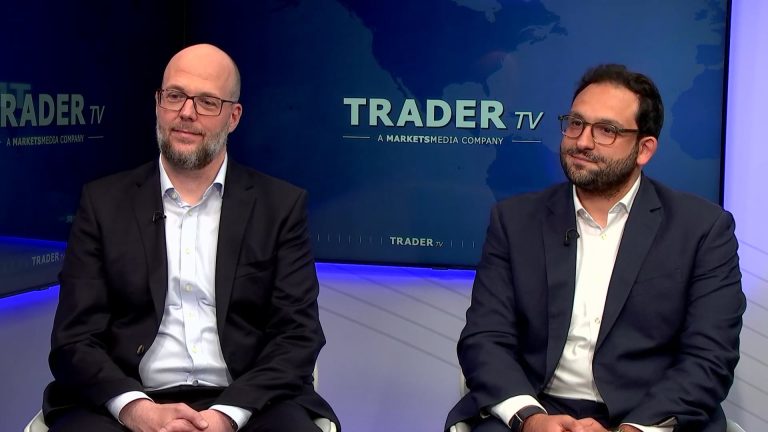
Amid heightened market volatility, buy-side traders are increasingly relying on multi-asset pre-trade analytics to make faster, more informed decisions. Speaking to Trader TV, Christopher Jarman, head of fixed income and Ritesh Marwah, managing director at BestX, discuss the importance of robust post-trade data for pre-trade analytics and how API (Application Programming Interface) integrations and advanced technology are reshaping trade execution.
The two also share their views on the need for interoperability, clean standardized data, and adaptable tools that cater to diverse trading styles across asset classes, as well as the growing consolidation of Transaction Cost Analysis (TCA) solutions on the desk.
Interview
Josephine Gallagher – Buy-side traders operate in high-pressure, volatile environments and need to make well-informed trading decisions. Chris Jarman and Rakesh Marwa at BestX are here to discuss the growing role of advanced analytics in improving trade execution and transaction cost analysis. And so, Chris, starting with you, how important is pre-trade analytics in the current market?
Christopher Jarman – Pre-trade is incredibly important. If we look at things like FX and equity, it’s very mature. For fixed income, it’s newer. So how we’ve approached it at BestX we’re looking at client data from a post-trade environment. Post-trade data is the foundation of all pre-trade, and getting post-trade right is particularly challenging. In fixed income, we use six data providers. We’ve got a lot of reference data that allows us to cluster bonds and better identify how something trades. Also, trading protocols become increasingly important. Understanding, a trade resistant for outright transaction, or if we have futures rolls or PTs (portfolio trades), and we can look at counterparty performance. You know, counterparty losing quotes. Having that readily available in a pre-trade environment ahead of trading is paramount to any trader. Now adding live market data to that, so things like Neptune become increasingly important, and it allows clients to better understand the current market volatility. In addition, we offer things like expected cost and liquidity metrics that allow us to show clients alternative investments and expected liquidity in their target instruments.
Josephine Gallagher – Ritesh, how does this now work from an operational standpoint?
Ritesh Marwah – There are three key pillars when you think about the whole process of pre-trade integration. The first one is interoperability. API in 2025 can no longer be a buzzword. It has to be something that seamlessly works across the integration process of every single trader. We need to make sure that all the decisions that the trader wants to make should be available directly where they execute. The second bit is clean market data sources. If we think about data, doing it for one asset class is challenging enough, doing it for three different classes is a completely different ball game. And what we are trying to do is to make sure that we can standardize the data no matter which platform we consume it from. At this very moment in time, in BestX, we consume market data and reference data from over 65 different sources, and you need to have a level of consistency if you want to provide pre-trade analytics back to your clients in a format that’s ingestible by all of them. There’s a huge amount of work that gets done by our quant team, our tech developers, to do that level of standardization, but within the last seven years, I think we mastered that very, very well. The last bit is adaptability, because now we are catering to three different asset classes. You need to always make sure that you have a flexible platform that allows the requirements of every single trader to be fulfilled. In the world of FX, it could be minimizing market footprint. In the world of fixed income, it could be minimizing risk transfer. The pre-trade analytics should be able to allow the traders to do what-if analysis on whichever requirement they have, and then do it exactly at the source of execution, where the traders need it. An effective pre-trade solution is one that provides creators clarity, control, and confidence about their decision-making.
Josephine Gallagher – And so how is multi-asset trading impacting TCA demand today?
Ritesh Marwah – So when we started the BestX platform in 2016. Our goal was very singular, which was to be the best provider of FX TCA analytics to all FX traders. But what happened in the next four years, we saw a huge consolidation where a lot of different trading houses actually wanted to consolidate all of their FX, equities, and fixed income trading under one umbrella. We needed to have a singular platform that caters to the requirements of FX equities and fixed income traders. We didn’t really want to shoehorn what we had been doing in FX into fixed income and equities. We wanted real market practitioners to come into the platform and then build it directly from scratch, which is what Chris has done for the fixed income world, and that’s what we have done for the world of equities as well. Because as much as we would like to see that the markets are quite similar, the dynamics and the benchmarks required for each asset class are completely different. You need customization at the ground level. Although you’re trying to provide a seamless experience to traders, you still have to speak the same language that is required from a trading standpoint to keep the product quite relevant. I think we’ve done a pretty good job at that in the last few years, and I feel like we will keep on continuing to push for innovation to make it a very relevant product which does not only cater the requirements of one asset class, but actually all three asset class in totality.
Josephine Gallagher – What is BestX delivery in order to support these new trends?
Christopher Jarman – So BestX is complete client-led, so we now have client advisory boards. We take input from each and every asset class and each and every client on what they want to see develop next. There’s been a lot of interest in EMS integration. So pre trade and fixed income delivers a lot of analytics that we’ve already mentioned, but moving that away from our UI into an EMS like TS imagine, we’re working on for a client right now. That will allow them to receive data via API on expected cost and liquidity, but also direct connectivity to the BestX UI to better understand the post trade environment for that particular instrument. Secondly, we’re looking at Neptune. Now, a number of our clients are already using their data, but to have that data alongside our pre-trade solution is going to add a lot of value to clients. So if we look at the ability to understand whether any of their counterparties are already axed in that position, or perhaps even have the “anti axe”, that’s invaluable. In addition to that, if we start to look at alternative instruments, we can see the client potentially wanting to express the view through another point on that curve using a similar instrument. And then finally, one of the flagship products that we’ve just launched is something called BestXecutor. Now this idea was pitched to me back in 2018 on the buy side, and it really takes data from something like BestX, looks at all of the results, comes up with an approach, perhaps for RFQ trading or algo trading, perhaps more passive or aggressive solutions, also looks at the peer data pool that we have at BestX in FX, and then can send that data directly to a venue. We’ve currently partnered with FX Connect, but we’re looking at alternatives as well. So that gives the trader the best chance of using all of the pre-trade information at the point of execution.
Josephine Gallagher – And so what’s next? How do you see TCA developing over the rest of this year?
Christopher Jarman – So as I mentioned, in FX, we’ve got kind of an industry-first buy-side-only FX data pool. We’re looking to expand that into fixed income. The protocols around fixed income are arguably some of the toughest data to get. Not all EMSs and OMSs store it particularly well. So we’re getting in touch with the major trading platforms to better enrich our client data. Secondly, Neptune. Neptune information at the point of trade is invaluable, but actually looking at it in post-trade is going to be a new initiative for BestX so understanding whether a counterparty said they were axed and actually they missed, is really important information for the trader. Additionally, if another instrument was chosen upon that curve, same credit, but a different point on the curve, did that counterparty that was axed in a different instrument still win that. That’s great liquidity provision that we want to share with our clients, and then thirdly, coming back to BestXecutor, we want to look at what-if analysis around the solutions and the protocols that weren’t chosen, what would have been the outcome had you chosen RFQ rather than the passive algorithm? I think that becomes invaluable. Looking at alternative solutions to execution and understanding when they’re not chosen, what could have been the likely outcome.
Catch Trader TV shows each week:
To watch Trader TV This Week shows go to – Video
Or make sure to follow us on LinkedIn – Trader TV’s LinkedIn
Available as a podcast – Link