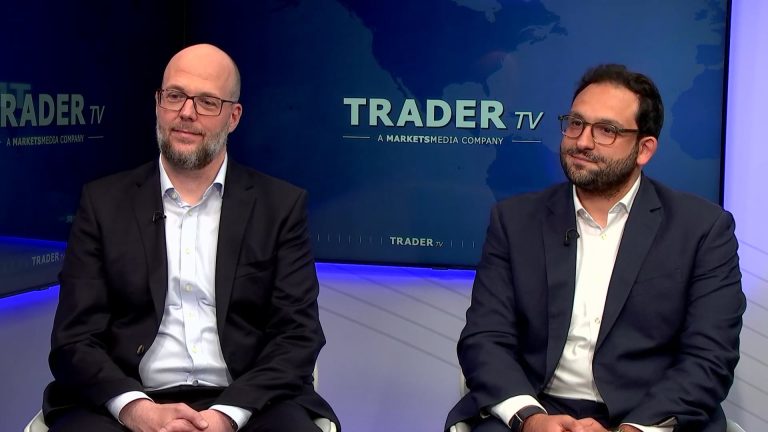
Matt Legg, managing director, at JP Morgan Chase & Co, speaks to Trader TV about where he sees growth in credit exchange-traded funds (ETFs) and the drivers behind this momentum. He says that buy-side adoption of portfolio trading is playing a role in fuelling demand for ETFs and improving overall liquidity conditions in the space.
As an ETF market maker, Legg unpacks how intermediaries like JP Morgan can better support their buy-side counterparts, through efficient pricing and managing risks.
And looking ahead, the JP Morgan executive discusses what’s next for credit ETFs and whether this growth, he’s seeing in passive investments, can be translated to the active space.
Interview Transcript:
Josephine Gallagher Welcome to Trader TV, your insight into institutional trading. I’m Jo Gallagher. I’m here at the Fixed Income Leaders Summit in Paris, and I’m joined by Matt Legg at J.P. Morgan to discuss developments in credit ETF markets. To kick us off, what are some of the big themes and developments you’re seeing in ETF credit trading?
Matthew Legg Within Europe, it’s been incredible to see the pick up of the product with credit specialist investors in the last 18 months. If we look back to the start of that period 18 months ago, almost all the flow that we would see on a daily basis would come from non-specialist investors, principally from equity trading desks; multi-asset investors looking to access the asset class. Now we see a much higher proportion of that total flow coming from credit specialist investors, hedge funds, credit credit-focused asset managers. If I look at the US, hedge fund usage of credit ETFs is well established and the use of the product as a trading asset is well established.
What has been interesting is the significant growth in the rest of the ecosystem, and the interaction of that with ETFs, most specifically portfolio trading. Portfolio trading of bonds has grown hugely this year, as has the flow in ETFs, and the two are fueling each other; so you’re getting growth in portfolio trading developing the liquidity you have in ETFs, and development in credit ETF trading fueling the growth in portfolio trading. And all of that together is helping to build a stronger ecosystem.
Josephine Gallagher Interesting, and so how have businesses like J.P. Morgan and ETF market making businesses for credit had to adapt as a result?
Matthew Legg Well, we’ve really had to ensure we are as efficient as possible in the way we manage risk. So the main thing we’ve tried to do is ensure that when we’re managing risk in ETFs, we have seamless interaction and integration with the single bond trading businesses, with the macro index trading businesses and with the portfolio bond trading businesses. It also means developing infrastructure and platform and connectivity between those different business lines so that they can all act as one. This helps us get to the most efficient output in terms of management of risk and therefore to the most efficient pricing.
Josephine Gallagher So, how have you now seen that translate into trading performance?
Matthew Legg Well, it’s fairly directly translated by improved spread – we’re one of the key liquidity providers for investors accessing the ETF market. So that has two impacts. One, the investors obviously able to access the funds more cheaply when we’re able to provide tighter prices, and that’s demonstrated by the growth in market share. So we’ve seen our market share double in certain segments of the market over the last year and grow strongly across all segments. On the other side, it’s benefiting the issuers because investors can only access their products through a liquidity provider like J.P. Morgan. And so part of the rationale to provide tighter pricing and to invest in the way we have is to enable investors to access their funds more cheaply, making the whole ecosystem more efficient.
Josephine Gallagher Okay. And now what are the next steps for the ETF credit markets? What do you envisage for the future?
Matthew Legg The big question mark going forward will be whether the same growth that we’ve seen in passive investment translates across to active. And will the investor preference that we’ve seen for the ETF wrapper in the passive space be replicated in the active space? We’ve already seen ETFs become the wrapper of choice in the passive space because of some of the economic efficiencies and the operational simplicity that they bring. And we also recognize and know and can see that for some active strategies, the transparency that ETFs provide are never going to be suitable.
But there’s a large range of assets which sit somewhere in the middle, and as investors continue to develop out their order management systems, they increasingly electronify the way they communicate orders, they put increased focus and investment into the risk management platforms which require look through to the underlying holdings that they have, and they lean more heavily on platform themselves, the ETF becomes a more and more appealing asset wrapper for that type of investment because it allows more look through into risk management, it fits well into the electronic OMSs, and the operational benefits that it brings become much more relevant as the whole ecosystem becomes more electronified. So if we see that transition of those benefits which have already been observed within the passive space travel over to the active space, then we would expect to see very significant growth in active ETFs, in fixed income ETFs, and in credit ETFs.
Josephine Gallagher I’d like to thank Matt for his insights and of course you for watching this has been Trader TV at FILS.