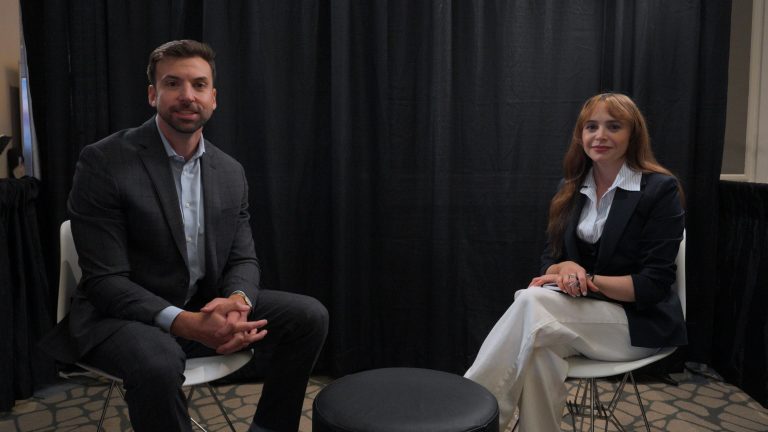
As market activity typically slows over the summer, trading desks will adapt their strategies to account for the drop-off and their expectations for vary central bank interest rate decisions this year. However, Andrew Claeys, head of systematic trading at Allspring Global Investors, says that the time is right to take advantage of interesting hedging and options opportunities for not only reducing market risk but also gaining attractive returns.
The trading head delves into how he is looking at the market through the lens of a systematic strategy and how his firm adapts its models over time.
In this episode, Claeys also discusses how far the industry has come in automating fixed income and if he ever envisages an outcome where we’ll see it become fully automated and we have wholesale zero-touch trading.
Interview Transcript
Jo Gallagher Welcome to Trader TV This Week, your insight into how trading desks can prepare for the week ahead, I’m Jo Gallagher. Today I’m joined by Andrew Claeys at Allspring Global Investors to discuss the main topics and events leading this week. Andrew, welcome to the show.
Andrew Claeys Thanks, Jo.
Jo Gallagher In the context of the upcoming week and the high rate environment that we’re operating in right now. How are you looking at the markets through the lens of a systematic strategy?
Andrew Claeys Right now we’re in the middle of summer, so volatility and volumes are extremely low and we have to be very careful and patient with putting trades on and managing liquidity and risk. But that also lends itself to some opportunities. So while liquidity is very price insensitive in the short term it appears more in terms of time. So if you’re patient with your trades and you work trades over a longer time horizons, you can actually achieve a better result. So what we tend to do in the summertime is slow our rate of participation down and trade things a little bit longer and a little bit slower, and we end up with much lower transaction costs by doing that.
Jo Gallagher And so then how do you adjust your models based on factor variation, rate cuts and events?
Andrew Claeys We really look at our models in a cohesive manner. So we’re trying to determine the number of factors that we can combine to get the best explanatory power from the model. We’re not necessarily altering the weights individually of those factors, but really looking at the best result in totality. So we have a whole host of fundamental factors; price to sales, price to earnings. Things that people are very familiar with, as well as technical factors like momentum and more price-driven factors. And we do that across all asset classes. But in doing that, we’re able to achieve a relative ranking or a relative value of set that gives us some opportunity to take advantage of things in more of an RVA or relative value arbitrage standpoint.
We’re really pulling in as much data as possible. We’re pulling in data for 12,000 equity securities, both fundamental and technical data. Sovereign rates globally, credit spreads, as well as we have partnered with a machine learning company to have automated news ratings so we can score news stories as they come out. So I think the more data you have, you can let the computers do the hard work of sifting through and determining what’s useful and what’s not.
Jo Gallagher Where are you finding the most interesting trading opportunities based on the way the market is looking right now, this kind of bimodal trend.
Andrew Claeys Or finding a lot of opportunities in equity volatility. If you look at equity index volatility around fed announcements, since the fed started raising rates, yet the at-the-money straddle has been underpriced consistently along with the S&P 500 top 50 or even the Mag 7. If you just would have just bought the at-the-money -straddle ahead of earnings announcements, for example, you would have produced a positive return.
There’s a lot of structural reasons why we think that will continue. And taking a step away from just pure alpha strategies, there’s also an opportunity with tail protection and hedging, where you might be able to reduce your risk without really damaging your return stream. So you could potentially use options or take advantage of the skew that exists in option trades to reduce your risk and still keep your return intact. And then I think lastly, what I would mention is the right tail. The right tail hedges are extremely cheap. Created a situation where even if you’re wrong, the trades will probably carry flat. That’s a very attractive opportunity. I think people need to take a look at right.
Jo Gallagher Taking a step back, what are your views in terms of how far the industry has come in automating fixed income?
Andrew Claeys There’s a large percentage of trades that have been automated in some asset classes, it’s north of 50%. U.S. treasuries that are on the run are an example and investment grade corporates are another where a large percentage of the trades are no touch. But not a large number of market participants have necessarily adopted automation. And I think the reason for that is that there’s kind of tiers of automation, meaning there are these very liquid trades that are automated, and then in the second tier there are trades that maybe are less liquid, harder to price, and take a lot of time and energy for traders. So they have a tremendous amount of benefit if they were automated and [would] reduced this trade and kind of workflow on traders and get them to focus on the more value, add portions of the trade. So I think that’s where we’ll see a focus in the next few months.
Jo Gallagher Do you ever envisage an outcome where fixed income becomes fully automated or we have zero touch trading?
Andrew Claeys I do, I mean, in some sense we’ve already achieved that in a few asset classes. Investment grade credit and on the run treasuries. There is a lot of zero touch trading. But I think looking at the difference between, you know, one click trading and one touch trading, where a human kind of reviews a basket of securities before they’re waived out the door versus the true kind of no touch, fully automated trading.
It’s a very fine line in terms of efficiencies, and I think it will come down to individual participants risk tolerance, whether they’re comfortable, fully automated in their trades. And if everyone got to kind of this one click trading environment where everything’s so preprogramed, counterparty selection, algo selection or execution protocol is fully automated. And the trader. Just reviewing it as kind of a final check. That’s pretty efficient. So I think that’s probably the kind of landing spot, but I think between the two scenarios, they should be, you know, very, very efficient compared to how things are being done or maybe were done in the recent past.
Jo Gallagher Thank you, Andrew, for your insight and, of course, you for watching. This has been Trader TV This Week.
Catch the show each week:
To watch other Trader TV This Week shows go to – Video
Or make sure to follow us on LinkedIn – Trader TV’s LinkedIn
Available as a podcast – here