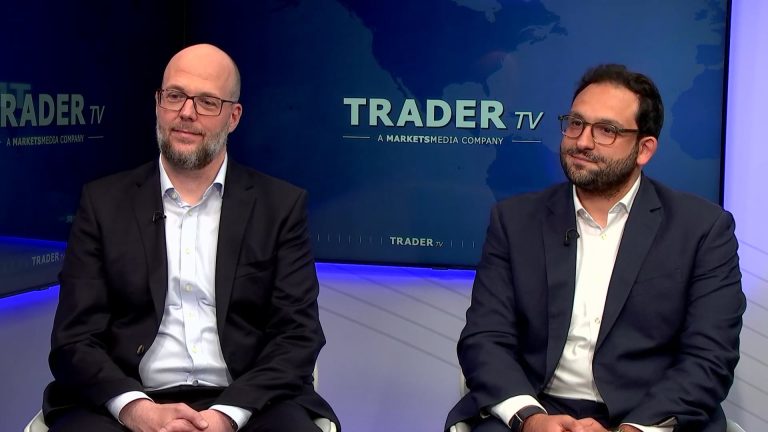
Despite heightened volatility, Jack Roberts and Liane Fahey of Tradeweb says credit markets are seeing growing confidence in automation and the use of pre-trade analytics. Speaking to Trader TV, they discussed how clients are increasingly using data-driven tools, varied protocols, and AI to navigate turbulent markets and reduce explicit and implicit costs—particularly in portfolio trading. As credit markets evolve, Roberts and Fahey, share their views on the role that pre-trade data is having on strengthening client-dealer relationships and the shift toward integrated, multi-asset trading workflows.
Interview
Dan Barnes – So if we look back on 2025 through the lens of trading, how would you characterize the year?
Jack Roberts – So from a trading perspective, we definitely saw periods of heightened volatility and challenging liquidity conditions throughout the year. Now, usually in those conditions, we tend to see dealers and clients step back from electronic trading and automation as a whole. Now what was interesting last year is we saw the opposite, totally. We actually saw a big uptick in clients wanting to automate more of their flows, particularly in the volatile periods. So if we look at it on a ticket basis, the level of automation in European credit remained pretty stable, but actually on a volume basis was where we saw the massive uptick. We worked quite closely with clients to build tools that could effectively monitor market dynamics and liquidity conditions and assign different rules based on those market dynamics. So it’s no longer just a one-rule-fits-all approach. So ultimately, that led to three trends that we saw. One, an increase in trading confidence in automation. Two, an increase in trade size through automation and three, challenging the notion that with volatile periods comes a step back in electronic trading.
Dan Barnes – That’s really interesting. Liane, as a former trader, I’d value your view on this, if we then take that as a backdrop moving into 2026, what do you think might change, and what sort of macro factors are affecting things?
Liane Fahey – So we expect credit markets to be as busy as ever, with record levels of issuance predicted for corporate markets. We’ve already seen a really strong start to the year. We’ve obviously got the macro backdrop bringing lots of uncertainty and weighing on sentiment. And of course, we’ve got the introduction of the consolidated tape for European and UK markets, which is the aim of offering greater transparency, better data analysis and helping traders make better decisions.
Dan Barnes – Very good. And how are you working with clients to potentially use that data. Is that more around explicit trading costs?
Liane Fahey – Yeah so we’ve always believed that post-trade data helps inform pre-trade decision making, so being able to have that colour and see what’s going on in the market at your fingertips at the time of trade certainly helps those execution decisions.
Dan Barnes – Yeah, and then Jack, if we look at explicit trading costs and then implicit trading costs, we know what data is going to do to explicit costs, what might it do to implicit costs?
Jack Roberts – Yeah so I think data supports trading cost management in a variety of different ways. When we think about trading costs for European credit, we’re typically thinking around not executing at the optimal level, not approaching the optimal counterparties or not executing with the optimal protocol, given the market conditions. Ultimately, moving data earlier in the decision-making process, can significantly reduce your chances of incurring some of those costs. Now, actually, one protocol that we saw that work quite well with was actually portfolio trading. Once clients became more comfortable with the protocol as a whole, they started to demand more data specifically pre trade. So we worked creating some AI models that would effectively allow clients to see their estimated cost and help with counterparty analysis specific for you as a client, and in the basket that you’re looking to trade. And I think what’s interesting, when we look at the stats for this year, 70% of portfolios that have been traded on Tradeweb have used pre-trade analytics before sending. So ultimately, really, once we move that data early in the decision-making process, it absolutely becomes an integral tool that people can use to reduce trading costs.
Dan Barnes – So would you say that data is actually helping to support the trusted relationships that can exist between the buy-side desks and the sell-side desks?
Jack Roberts – Definitely, I think ultimately, it’s a positive feedback loop. So the better data that dealers do tend to provide can then help support decision-making for clients to know exactly which counterparty to go to.
Dan Barnes – We’ve talked about European credit there. What do you think is going to be happening in terms of the evolution of multi- or cross-asset trading this year?
Liane Fahey – Yeah, Dan, so we’re definitely seeing the rise of multi-asset trading, and clients are demanding more from us as an electronic platform in the way of tools to help assist that. So for example, if we’re looking at portfolio trading, clients increasingly want to see the relationship between the ETF (Exchange-Traded Funds) premium and discount at the time versus their underlying bond pricing. Also, the expansion of protocols, so allowing credit traders to hedge their portfolio, for example, or looking at portfolio trading for government bonds. We’re also seeing the convergence between rates and credit and the expansion of protocols to support that trading, ultimately allowing traders to do more with less.
Dan Barnes – So, where people are using one as a hedge against the other, for example, all of that can actually be more integrated into a single workflow.
Liane Fahey – Exactly, yeah, so corporate traders hedging their portfolios or rates traders wanting to trade a portfolio of government bonds, for example,
Dan Barnes – Very good. So we’ve talked about what traders do have, what’s still missing for traders in terms of what they might need to deliver optimal best execution this year?
Jack Roberts – Yes, I think, look, we’ve seen how important data can be, and for portfolios, we’ve noticed that it can support decision making and alpha extraction when trading portfolios. Ultimately, we’re working on something similar for the RFQ space, and eventually, the idea would be linking the two together to hopefully allow clients to protocol optimize their workflow.
Dan Barnes – Very good, Liane and Jack, that’s been fantastic. Thank you.