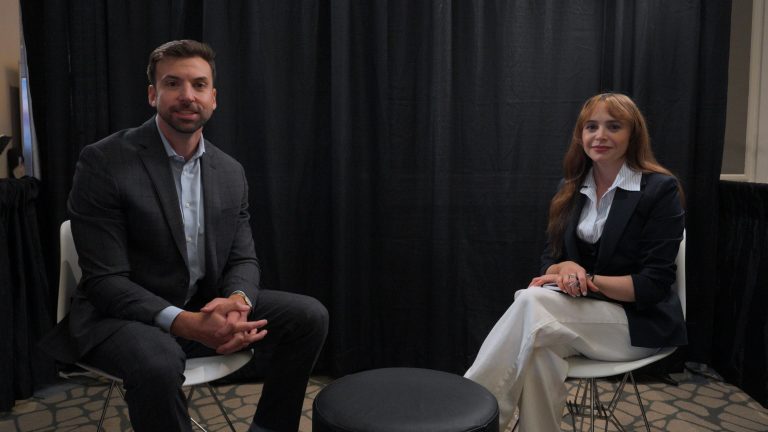
Trader TV speaks to Izzy Conlin, head of institutional credit at Tradeweb, about inefficiencies in credit markets and how much of the electronically traded market still relies on fragmented systems like chats and spreadsheets, creating major challenges in matching buyers and sellers.
Conlin looks at the development of dealer-initiated protocols, designed to centralize workflows and improve liquidity transparency. She also discusses the growing role of AI, analytics and benchmarking in distinguishing liquidity signals from noise, building trust in data, and complementing existing protocols like request for quotes (RFQs) and portfolio trading.
Interview
Jo Gallagher
So, much of the industry operates on fragmented systems such as spreadsheets and siloed chat systems. From your perspective, what challenge does this create for market efficiency?
Izzy Conlin
It creates a lot of challenges, and I’d argue that, you know, 50% of the marketplace that is not traded electronically, tends to be this area that’s quite fragmented, and it’s larger size trades, block axes, less transparency, less liquidity, and traders – both dealers and buy side clients – are getting pieces of information over all these different disparate systems; chats, runs, emails, phone calls. It’s very hard to make sense of all that, and it’s very hard to match up buyers and sellers, and actually make a quick and informed investment decision. At Tradeweb, we’re actually really excited about a new protocol that we’re launching in conjunction with our dealer community, who’ve really partnered with us on this. We’re calling it Target Trades. It’s a brand new, first of its kind, targeted Axe, and we’ve sort of flipped the script; where, usually in electronic trading, it’s the buy-side who initiates that RFQ or the portfolio trade to the dealer. Now actually the dealer can do that, and so we’re taking all the benefits of an electronic trading workflow and all the data and analytics that goes into it, and we’re saying, ‘what if we gave that tool to the dealers?’ And so use cases so far for this could be a portfolio trader at the dealer just took down a very large portfolio trade, and they have some very high quality Axes that they want to recycle to that client base. They can now do that via Target Trades. Maybe there is some very high quality inventory items that a dealer has that they want to show a client who said that they were really interested in the energy and TMT sector, and they have some high quality Axes there. They can do that via Target Trades. And the nice thing about this protocol is you get all the benefits of an electronic trading platform, with all the post trade and STP, but it’s centralized in one place with all the analytics you need to make that trading decision. So we’re really hoping that protocol will help the areas of the credit market that continue to be quite fragmented. We’ve gotten a lot of positive feedback so far, and we’re very excited about this rollout.
Jo Gallagher
Some of the biggest problems that buy-side and sell-side face today is trying to separate liquidity signals from noise. So, what is the industry doing in order to try and resolve some of those problems? And what does an ideal workflow look like?
Izzy Conlin
I think electronic trading platforms have done a really good job with some of the workflows and protocols that they’ve come out with so far, around watch list alerting capabilities, maybe upstreaming some of the pre-trade content to an order management system, for example – but I do think there’s a long way to go. What I am really interested in, and I know at Tradeweb, we’re very focused on it, is actually how AI can help with some of the aggregation and understanding of all of this data, around figuring out what really is noise versus what’s a signal. And everyone has sort of a different investment thesis, and so you have to figure out exactly what someone is looking for, but I’m excited to see what type of models or use of AI is going to impact our markets in the future.
Jo Gallagher
So, analytics and benchmarking are playing a growing role in helping firms to make decisions and also evaluate liquidity. How important is that transparency element in, you know, building trust between dealers and clients? And what are the limitations to that?
Izzy Conlin
We are still a very relationship oriented business in the credit market, and so the trust that you have between your counter parties and dealer and client is paramount. But I also think that trust in information is actually becoming one of the most important things going forward. And when I was trading 10 years ago, I didn’t have the wealth of data and information that we have now; whether it’s composite pricing information, sort of more benchmarking to a close and pricing to a close. And as it continues to get better and the marketplace evolves, there has to be a trust in the data and the composite pricing that you’re seeing to make these informed investment trading decisions. And at Tradeweb, we’re really focused on this, and think analytics and data is going to play a pivotal role in all of the workflows going forward in electronic trading. And so we’ve actually done a lot around real time analytics in our trading tickets. RFQ Edge, for example, is portfolio style analytics in our RFQ tickets. We’ve always been first movers in analytics in the portfolio trading tool, but we’re adding more and more analytics and data to our workflows, and I think that’s what the clients and dealers are asking for. So I think trust in data and information is the most important thing going forward.
Jo Gallagher
So, as protocols like PT, voice and dealer-initiated workflows evolve, what does that say for the direction of credit markets as a whole? And do you see these tools complementing one another, or competing?
Izzy Conlin
Very much complementary. We don’t see these workflows or tools as competing with each other. And what’s interesting is, as we launch new workflows and protocols, it actually is sort of uncovering new challenges that we want to solve for. And we were first movers in portfolio trading, we have the RFQ protocol, voice protocols, and now Target Trades – we think all of these things are providing different ways for the traders to ultimately achieve their investment objective. At Tradeweb, we want to provide choice, and so we continue to launch new workflows based off of the challenges that we’re hearing in the marketplace, and what our partners are looking to do; so I very much view them as complimentary, and I’m excited to see how it evolves.
Catch Trader TV shows each week:
To watch Trader TV This Week shows go to – Video
Or make sure to follow us on LinkedIn – Trader TV’s LinkedIn
Available as a podcast – Link