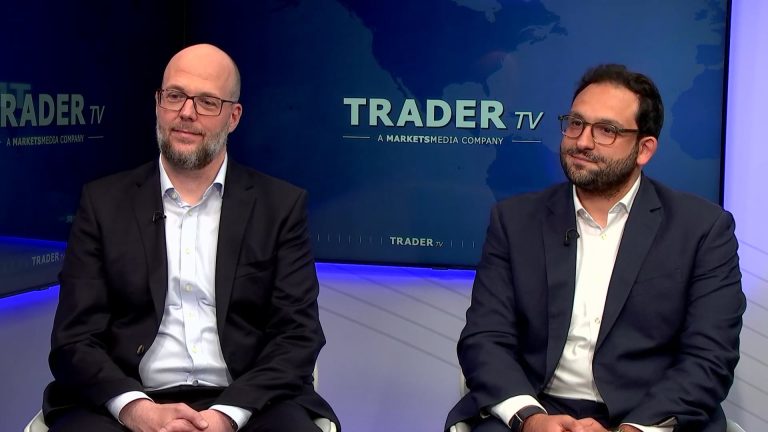
AI, automation and growth in portfolio trading are becoming central to the next stage of credit market electronification, says Jason Quinn, chief product officer and global head of sales, and Justine Robertson, US head of credit sales and client strategy at Trumid. Speaking to Trader TV at the Fixed Income Leaders’ Summit in Boston, Quinn and Robertson discuss how advancements in smarter execution tools, dealer-to-client streaming, PT capabilities, and enhanced analytics are helping market participants navigate rising trading volumes and increasingly complex workflows. As the credit space matures, they expect future innovation to focus on integrating intelligent analytics across execution protocols in a bid to improve liquidity access and smarter trading decisions.
Interview
Josephine Gallagher – Welcome to Trader TV. We’re here at the Fixed Income Leaders’ Summit in Boston, and I’m joined by Justine Robertson, U.S. head of credit sales and client strategy, and Jason Quinn, chief product officer and global head of sales. Justine, Jason, welcome.
Justine and Jason – Thanks for having us.
Josephine Gallagher – Great to have you here. So, okay, we’ve seen a lot of advancements in the electronification of credit over the last year. But from your seat, where are you seeing the biggest progress?
Jason Quinn – Well, we were at the conference last year, and three big topics that came up were streaming, so dealer-to-client workflows in the credit space, portfolio trading, and of course, automation. So I can cover the first topic. Dealer-to-client streaming, we made a lot of advancements there. Every dealer is connected to Trumid, for example, to stream. We’ve been in the game for seven years, trying to advance the ball on how that workflow comes together. There’s more work to do for sure, but what we’ve actually done over the last 12 months is introduce a tool called Smart Voice, which helps streamline the ticketing process. Which, if you do a trade voice, you still want to book it. You want to take advantage of all the post-trade workflows and US Treasury flexibility in automation. And we’ve estimated that Smart Voice has eliminated more than 100,000 clicks year to date, just by leveraging AI to parse a conversation for the ticketing process.
Josephine Gallagher – Okay,
Justine Robertson – And as it relates to portfolio trading, portfolio trading is definitely part of the trader toolkit now. At Trumid, we’re seeing buy-side engagement at record highs. That’s not just a typical month-end flow for PT, but also intra-month, and the numbers in the market are supporting that, right? It’s somewhere around 12% of TRACE volumes are now PT, and that’s more than doubled over the last three years. I really think what we see is that there’s been built to trust in the tools that allow traders to make the decision whether to do a PT or not, and the accuracy is really important. So that’s where the engagement is coming from.
Jason Quinn – Yeah, and on the automation front, you know, we brought it up last year. We’ve tried to carve out new territory, introducing cross-protocol automation workflows. We think that’s critical for the go-forward. The more ways you can trade electronically, the more cognitive load you might introduce to your client. So you have to figure out a way to automate it. That’s the way to simplify the workflow in the end, and allow those clients to more seamlessly get access to that liquidity.
Josephine Gallagher – Okay, really interesting. And also, Justine, you were on a buy side wish list panel this conference. So what did you learn from that?
Justine Robertson – Well, what we’re hearing is that there’s more data that’s in the marketplace for traders to actually have to sift through and make trading decisions every day, and it’s really not going to go the other way. That trading volumes continue to grow at a pretty healthy clip, and that just means that it’s going to become a prevailing issue that needs to be addressed. Where from our seat, where we think we can help is, and we continue to kind of invest in is aggregating that data, whether that be dealer streams, as we discussed, pricing inputs like FVMP, just to guide traders to make more informed decisions. But we’re really focused on kind of the holistic trading experience. Not only the aggregation of the data, but also the execution part on top of it. And so we’re excited about what we can continue to develop on our platform to enable clients to make more informed decisions.
Josephine Gallagher – Okay, and now, if I could ask you to take out your magic eight ball and project what could happen over the next 12 months in terms of progress, in terms of the electronification of fixed income markets, what’s, you know, going to be the biggest impact on execution desks and access to liquidity? What would you say?
Jason Quinn – Yeah, well, at the conference this year, no surprise, AI was, you know, voted as one of the main things that’s going to drive innovation forward in the market. Listen, at the end of the day, AI is non-deterministic, especially if we’re talking about large language models. So, making trading decisions feels a little far-fetched going 12 months out. But I think a lot of institutions that seemingly are more open to leveraging these tools than obviously previously would have been expected are going to figure out more and more ways to leverage it in their workflow to streamline what they’re doing, and that’s pretty exciting if you think about it.
Justine Robertson – And from a pricing and intelligence perspective, I think you know what we’re hearing, and we’re hearing this at this conference, is we’ve made a lot of progress in the market. You know whether it’s our analytics on our platform or others out there. There’s still a lot more work to do, and I think where we’re most focused, kind of on the go-forward and what you should expect to see from us, is more about kind of the optimization across workflows. Not only just providing analytics in kind of a protocol-specific way, but being able to kind of overlay it across all the various different ways that a client could actually execute a trade, so we’re pretty excited about that.
Jason Quinn – Yeah, and listen, we’re going to we’re going to develop more and more tools and analytics, but at the end of the day, we really need to put those all together in an elegant and intuitive way. So we’re still at Trumid very focused on design and UX because in order for a client to get the value from what. We’re doing whether it’s an AI tool or automation or something we develop on the analytical side to help them make their decisions. It needs to be clear and obvious. It needs to be very usable. That’s something to me that we’re always going to be focused on.
Josephine Gallagher – Okay, brilliant. I’d like to thank Justine and Jason for their insight, and of course for watching. This has been Trader TV at FILS in Boston.