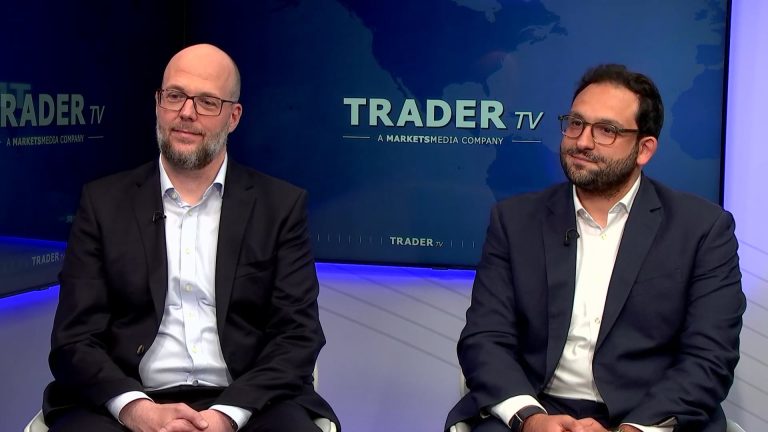
Andrew Dassori from Wavelength Capital Management discusses how the firm’s systematic trading approach is designed to filter out geopolitical and busy market noise by focusing on fundamental drivers.
Speaking to Trader TV, the founder and chief investment officer unpacks the core predictive signals his team use to inform his trading and investment models.
He also shares his thoughts on where he is seeing emerging signs of global diversification, beyond US assets, and points to growing concerns in the AI capital expenditure cycle.
Internally, however, the CIO speaks to how his firm is developing valuable use cases for AI and where it’s being applied to its buy-side desk.
Interview
Jo Gallagher – Your buy-side firm uses systematic trading strategies. What inputs and signals are going into informing your models, especially in the context of the current geopolitical environment?
Andrew Dassori – Well, we founded Wavelength over a decade ago, based on a lot of the changes that we saw taking place in markets. We invest using a systematic approach that uses quantitative tools to process fundamental market and economic information. As you pointed out more recently, there’s been a lot going on geopolitically that’s increased the level of noise for investors. Our process is really designed to limit that noise so we can focus on signals where we do have predictive power, and we do that by breaking down markets into their fundamental economic drivers based on growth and inflation, and then balancing our exposure to the potential outcomes for those factors. As a result, we’re pretty insulated from a lot of that back and forth, whether it’s driven by the headlines in Venezuela, what’s happening at the Fed or the next shoe to drop coming out of Davos this week. By limiting that noise, we’re able to focus on signals where we do have that more predictive power, where we do have an edge in order to drive our investment decisions.
Jo Gallagher – What are some of these signals with more predictive power, you mean?
Andrew Dassori – So we have signals in three types of categories based off of carry, momentum and value. Our momentum signals are really price based signals, while carry and value signals have more of a fundamental anchor, and those are really the types of factors that are going to drive our active investment decisions.
Jo Gallagher – So are you seeing any meaningful outflows out of US assets and a shift towards global diversification?
Andrew Dassori – Well, there is that old adage that diversification is the only free lunch in investing. In the past year has certainly been a good reminder of that for investors. Just looking at face value for both stocks and bonds, we’ve seen emerging markets outperform the US pretty significantly in 2025 and that outperformance would have been even more significant if it weren’t for the massive counterbalancing force of AI investment in the US. The other place you can see a lot of those shifts has been the US dollar, where we’ve seen pretty significant depreciation over the first half of the year. A lot of that momentum has faded more recently, but it’s definitely a place to watch something that we’re monitoring pretty closely for, reacceleration in the coming year. Overall, though, I think it does make sense to have different risk premia in different parts of the world. We saw that shifting over the past year. That should really be a good reminder for investors about why markets are constantly changing and why diversification is a logical way to help investors prepare for what can happen next.
Jo Gallagher – With earning season underway as well, investors are focused on AI capital spending right now as well. So what stage do you think we’re at in the AI investment cycle, and should we be worried about long-term concentration risk?
Andrew Dassori – Sure, I should just start by saying this is not a typical Capex cycle. For one, because of how AI can threaten existing business models, and also because of how businesses see that opportunity. On the other side of the spending, it just simply doesn’t align with the normal profit incentives. With that being said, there are clearly risks that go alongside these opportunities, and there will be companies that get out over their skis. That’s natural, particularly at a time like this, when the AI ecosystem is changing so quickly. At more of a macro level, though, I see the key risk in how growth has become so concentrated in AI to the point where issues at a single company could spread and have a broader economic impact than what markets are more accustomed to.
Jo Gallagher – Also a lot of buy-side firms are trying to integrate AI into their own trading processes. What stage is your own firm in its AI journey?
Andrew Dassori – Well, we built our process over a decade ago as an expert system that uses computers to analyze data more effectively and efficiently than what would be humanly possible. We’ve continued to build on this as new tools and become available. We’ve added new methods of analysis, like recurrent neural networks to analyze the yield curve, natural language processing to measure sentiment, and that’s really been the research mission, pulling in different concepts from academia, et cetera, in order to enhance our process. Generally speaking, though, what’s becoming available with the current AI boom has really improved our ability to come up with and test new investment ideas, but without those typical human constraints, limitations on their capacity for analysis, just really limitations in their ability to reason. So with that in place, I think the next step is really combining these new techniques with reasoning, and that’s a key research focus for us as we approach this next frontier for investing.
Catch Trader TV shows each week:
To watch Trader TV This Week shows go to – Video
Or make sure to follow us on LinkedIn – Trader TV’s LinkedIn
Available as a podcast – Link