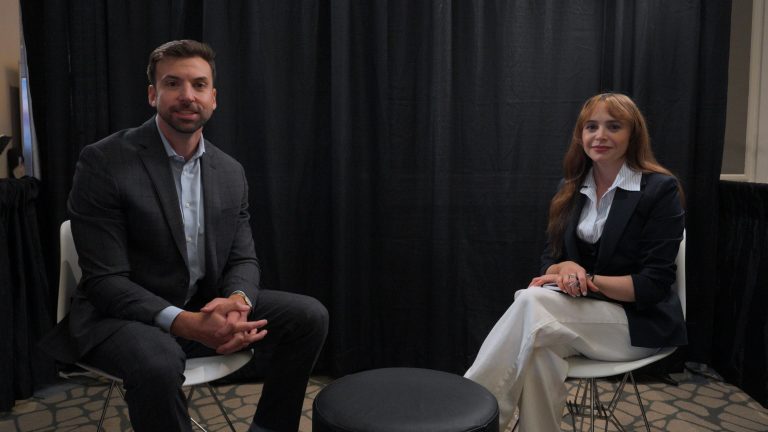
Markets are on edge as global interest rates could be nearing an inflection says Andrew Dassori, founding partner and chief investment officer at Wavelength Capital Management. The CIO discusses mixed economic data signals and where he sees the potential for an uptick in volatility this week.
Dassori shares his views through a systematic trading lens but also provides insights on interesting opportunities emerging due to global policy divergence and rate cycles. In this episode, he unpacks how the buy side uses, manages, and prioritizes data inputs, during spells of low and high volatility.
Additionally, Dassori delves into where he sees artificial intelligence making the biggest impact across the trading desk and looks at some of the major risks associated with the rapidly growing technology.
Interview Transcript
Jo Gallagher Welcome to Trader TV This Week your insight into how trading desks can prepare for the week ahead, I’m Jo Gallagher. Today I’m joined by Andrew Dassori and Wavelength Capital Management to discuss the main topics and events leading this week. Andrew, welcome to the show.
Andrew Dassori Thank you.
Jo Gallagher To start us off where are we in the global rate cycle and how would you be advising trading desks going into the upcoming week?
Andrew Dassori So we’re at what may be a key inflection point for rates in the economy. In the week ahead, we get critical data on where we are in that cycle and potentially what the path will look like moving forward. So just taking a step back at Wavelength, we have a systematic investment process that uses quantitative tools to process fundamental market and economic information. And through this lens, we’re looking to limit the impact of economic uncertainty and with a transition like this going to avoid making any big directional bets on any particular outcome. Instead, we’re assessing markets based on their probabilities, knowing that lots of things can happen, particularly in a week like this.
In that context, we’ve already seen a rise in volatility from soft employment data last month, followed by better-than-unexpected consumer data that eased many investor concerns. Given those mixed signals, markets are understandably on edge facing a key test in the monthly jobs report this week. If that data comes in stronger than expected, it will show signs of really what’s been a remarkably durable economy at this stage in the cycle. If that data is weaker than expected, growth concerns will likely come back and show the impact of higher rates is now flowing through markets to the underlying economy.
Jo Gallagher As you said, you see things through a systematic lens but if I were to push you, where do you see opportunities to put trades on?
Andrew Dassori Well, at this point in the cycle, after a period where central banks have really moved in lockstep and been more coordinated, we’re now seeing meaningful differences in economic conditions across countries and how policymakers are managing. The clearest example here is Japan. But more broadly, inflation coming down at different rates in different places is leading to opportunities, particularly in foreign exchange markets and global bond markets.
As these policies diverge, we think that we can identify these different mispricing systematically with relative carry momentum and value factors. As the cycle continues things will be likely less and less synchronized. I expect the opportunity to trade across asset classes and economies will continue to grow.
Jo Gallagher Some economic data can be subjective, and often it’s difficult to understand what to prioritize. How do you manage that type of data input, especially during periods of low and high volatility?
Andrew Dassori When it comes to economic data we’re really focused on relationships with asset prices. We test these extensively, in some cases going back over 100 years’ worth of data. But before any testing, we do look to find a logical reason why that relationship would exist, and that baseline economic intuition helps guide our process and avoid some of the spurious correlations that other asset managers may be subject to. An example here is corporate credit, where spreads have a relationship with growth.
That follows pretty straightforward economic logic. When growth rises, companies generally have better revenues that translate to better balance sheets and that will be indicative of a better credit quality. This makes sense intuitively, but it’s also something that you can test with data going back to confirm whether or not that logic holds. With that being said, there certainly can be times when volatility or selling pressure really overwhelms those relationships, and asset prices will disconnect from their fundamental drivers.
Over the long term though, economic relationships are largely resilient and provide a consistent and fairly reliable framework for us to look at markets and assess markets across the globe.
Jo Gallagher Artificial intelligence and its use across the front office is a very important topic to our viewers. Where do you see AI making the biggest impact on the trading desk?
Andrew Dassori Well, I have certainly been a popular topic and it’s something that I do think will be transformational. What’s important to highlight is that it’s been around since the 1960s, and it’s something that systematic traders have been using for decades. With that being said, this new generation of AI has a deeper set of capabilities and what’s been possible in the past when working with technology.
We’re already seeing copilots for things like writing code that enhances productivity, and that is huge for systematic traders. We’re also seeing the rollout of large language models that are trained on financial data from providers like Bloomberg and others. These don’t have an important layer to guide and judge their outputs, but they’re able to explore data at a scale that just simply isn’t possible by humans, even at the largest firms.
So zooming out, that general ability to identify relationships and markets using AI has incredible scale to research functions and a new dimension to how trading decisions can be made. But also, it’s important to recognize that this will come with new and considerable risks that will need to be managed accordingly.
Jo Gallagher What are some of the risks associated with the adoption of AI, and what do traders need to be more mindful of?
Andrew Dassori We’ve all now heard about AI hallucinations, so people aren’t using ChatGPT for things like medical advice. When it comes to financial markets there are clear parallels that could also be pretty costly. The key risks are really from what it would be a lack of guidance and human reasoning. This is something that other statistical approaches do run into.
These are type two errors and that’s really when a relationship is trusted that actually isn’t there. There are plenty of examples of this in that long list of hedge fund blow-ups over the years. So it’s something that we are well familiar with. And like any other type of investing with fiduciary duty supervision is really critical. Whether that’s for human beings or for machines.
So given all that, I think there are people out there who are equipped to use it, and for those people, AI represents a massive opportunity to build a scalable research process where ideas can be pulled out of data sets, validated with human intuition to provide new and what I would say is a pretty remarkable source of alpha for investors.
Jo Gallagher Thank you, Andrew, for your insight and of course you for watching. This has been Trader TV This Week.
Catch the show each week:
To watch other Trader TV This Week shows go to – Video
Or make sure to follow us on LinkedIn – Trader TV’s LinkedIn
Available as a podcast – here